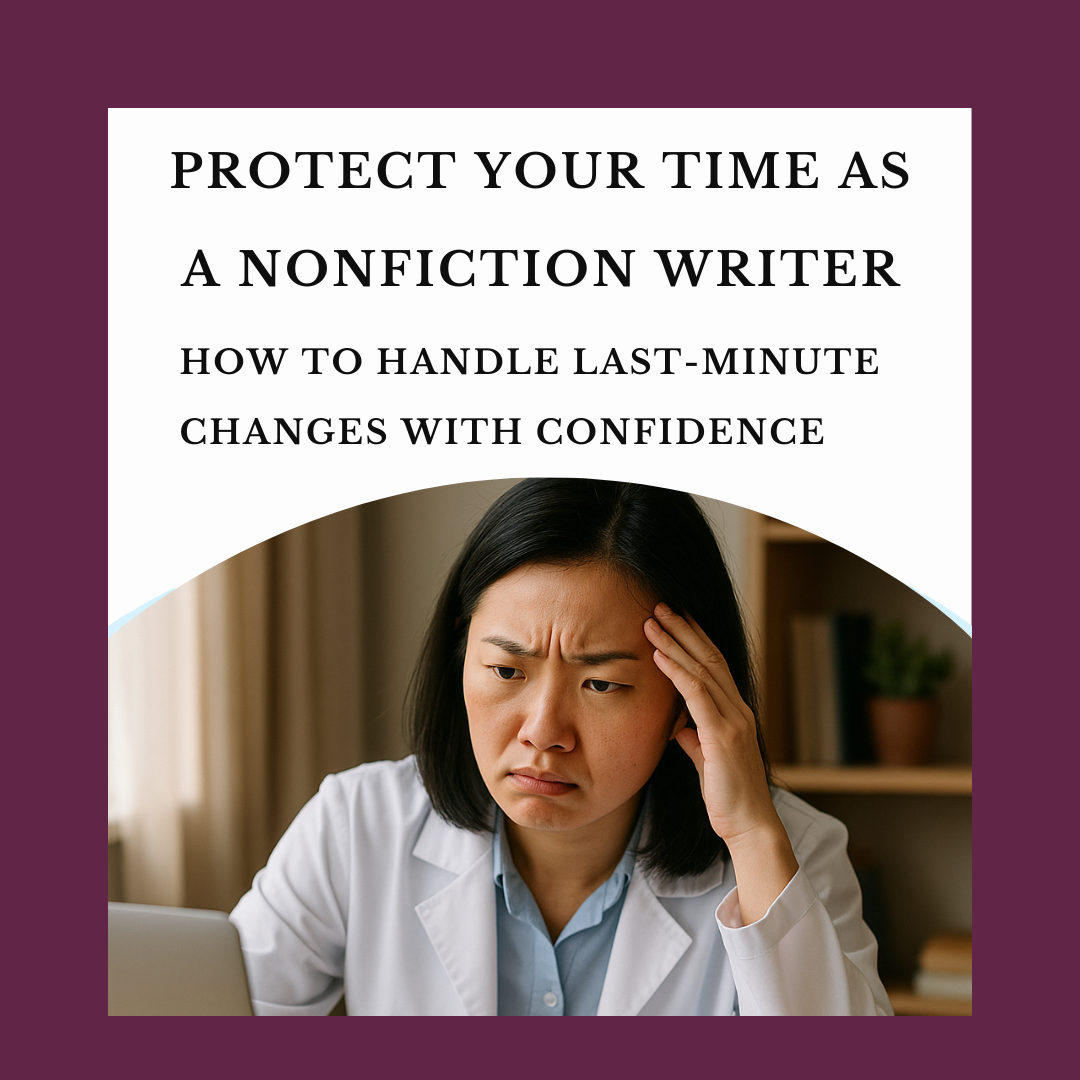
Protecting your time as a nonfiction writer isn’t just about blocking off hours on your calendar. It’s about being intentional with your energy, your focus, and your boundaries, especially when professional opportunities shift without warning.
Maybe you’ve been here before:
You agree to speak at an event, contribute to a panel, or mentor writers in a program. You prep carefully. You clear your schedule. You want to do a good job.
But then the day arrives, and everything has changed.
The format is different. The time is cut. Your role has shifted. And the thing you spent hours preparing? It’s either no longer needed or gets reduced to a quick aside.
It’s disorienting. It’s frustrating. And it can make you question whether you misunderstood something or just weren’t flexible enough.
Let’s be clear: You didn’t do anything wrong.
This happens far too often, especially to nonfiction writers who bring professional expertise, academic credentials, or lived experience to the table. You’re invited because you bring value. But you’re not always treated like a true collaborator.
This post is here to help you navigate those moments without burning out or burning bridges.
You’ll learn how to:
- Ask 5 Questions Before Saying Yes
- Set healthy, professional boundaries up front
- Respond clearly when expectations shift
- Decide when to walk away and when to roll with it
If you’ve ever walked into a gig and thought, This is not what I signed up for, you’re in the right place.
Let’s talk about how to protect your time and protect your voice while you’re at it.
When the Plan Changes
You prepare for one thing, and then things change at the last minute.
Maybe your talk gets cut from an hour to ten minutes. Maybe you’re suddenly expected to coach instead of present. Or maybe you find out, in real time, that your contribution isn’t even needed the way you thought it would be.
That’s not just frustrating. It’s disorienting. You spend days, sometimes months, getting ready, only to be asked to pivot on the spot. What you planned, practiced, or cleared your schedule for? It’s gone.
Even worse, these shifts often come without a heads-up. No conversation. No check-in. Just a quiet assumption that you’ll go with the flow.
And the thing is, you were probably invited for a reason. Your credibility. Your insights. Your background. You were there to add value.
But when the plan changes without warning, it can start to feel like your presence mattered more than your preparation. Like you were brought in to validate something, not contribute meaningfully to it.
This kind of treatment isn’t random, and it isn’t rare.
It tends to show up more for women, writers of color, and professionals with formal credentials or lived experience. People who are often asked to “lend credibility” but not always given the space to lead or fully participate.
It’s not always intentional. But it is a pattern. And recognizing it is the first step in protecting your time, energy, and self-respect.

Take a moment here:
- Have you ever said yes to a writing-related opportunity, only to find out it was something else entirely once you showed up?
- How did that feel?
- What would you have needed in that moment to feel more supported or respected?
Next, we’ll look at what it really costs us when we stay flexible by default, and how to know when it’s time to pause and reassess.
The Real Cost of Always Saying Yes
We’re often told that being flexible is a virtue.
Say yes. Be easy to work with. Don’t make it a big deal. Especially if you’re just starting out or trying to build your platform.
But always saying yes, especially when things change last minute, has a cost. And it’s not just time.
What it actually costs you
- Hours of preparation that go unused
- Lost momentum on your own projects
- Emotional whiplash from having to pivot quickly and perform anyway
- Resentment even when things technically go “well”
This kind of over-flexibility chips away at your focus. You might still show up and do a great job, but inside, you’re burned out, disconnected from your writing, and starting to wonder if the effort is worth it.
You’re not alone if you’ve felt that.
Flexibility isn’t the problem. Assumed flexibility is.
It’s one thing to say, “Yes, I can adapt,” because you chose to. It’s another to be expected to adapt without any discussion.
And that’s often the unspoken expectation, especially for women, people of color, and writers juggling multiple roles. The assumption is that you’ll just make it work. You’ll be gracious. You’ll do what’s needed.
But here’s the thing: protecting your time isn’t selfish. It’s strategic.
It allows you to keep showing up for your own work, not just everyone else’s.
A quick gut check:
Think about a recent writing-related commitment. Did it leave you feeling energized and respected or drained and frustrated?
That’s useful data. Not every experience will be perfect, but the pattern matters.
Next, we’ll talk about how to break that pattern with boundaries that are clear, professional, and doable even if saying no doesn’t come naturally.
Boundaries That Work
Let’s talk about boundaries, not the cold, rigid kind people assume you’re setting, but the kind that actually help you stay clear, present, and focused on your writing life.
As a nonfiction writer, you’re likely balancing more than just your own projects. You might be speaking, teaching, mentoring, freelancing or doing all of that alongside another career. So when someone asks for your time, it’s not just a calendar question. It’s a capacity question.
And that’s why boundaries matter.
Boundaries aren’t about pushing people away
They’re about making it easier for others to work with you, not harder.
When you’re clear about what you can offer, and just as clear about what you can’t, you save everyone time and prevent resentment from building later.
Boundaries give you room to prepare well, contribute meaningfully, and recover afterward. They protect your creative energy so you can keep showing up for the work that matters most to you.
You don’t have to be rigid to be clear
You can still be thoughtful. Still generous. Still collaborative.
But being clear means:
- Asking questions before you say yes
- Confirming expectations in writing
- Speaking up when something changes
- Saying no when a request pushes beyond your limits
And here’s the best part: the more you practice, the easier it gets. You build confidence in your voice. You become someone others can trust to be honest. You learn how to show up fully, without overextending.
In the next section, we’ll walk through exactly what to say when a plan shifts or a boundary needs reinforcing so you’re not caught off guard without the words.
Want help setting boundaries that fit your goals and your writing life? Check out my coaching packages to see how we can work through this together.
What to Say When Things Shift
When something changes last minute, especially in a writing or speaking gig, it can be hard to know what to say in the moment. You don’t want to seem difficult. But you also don’t want to just absorb the change without acknowledgment.
Here are a few grounded, realistic responses you can use, depending on the situation.
If the plan shifts and there’s no time to discuss it
Sometimes you’re in the room or on the call when you find out the expectations changed. You’re already live.
You can still name the shift calmly:
- “Got it. This isn’t quite what I prepared for, but I’ll adjust as best I can.”
- “Okay, I’ll pivot, but it may be a little less focused than what I had planned.”
- “Alright, I’ll do what I can with what I have.”
You’re showing up but on your terms.
If you do have a chance to clarify before moving forward
- “Just checking: are we changing the format from what we originally confirmed?”
- “I’m happy to be flexible, but this is different from what I prepped. What’s most helpful from me right now?”
- “This feels like a shift. Can we quickly align on what you’re hoping I’ll contribute?”
These invite clarity without conflict.
If the request goes beyond what you agreed to
- “That’s outside what I prepared for today.”
- “I’m not set up to do that well right now, can we stick to the original plan?”
- “Happy to revisit that later, but I’d like to stay within what we discussed for today.”
You don’t need to overexplain. Short and steady works.
If you need to decline
- “I’m going to pass on that, it’s outside what I can give right now.”
- “That’s not the right fit for me, but I appreciate the ask.”
- “I’m not able to take that on at the moment, but I’d be open to reconnecting later.”
You’re not slamming the door. You’re simply being clear.
You don’t need the perfect words. You just need a moment of pause and a go-to phrase you feel comfortable using.
And if you want to build a few of your own, try writing them down now, so they’re ready when you need them.
Next, we’ll walk through five questions to ask before saying yes to anything so you’re less likely to land in that scramble to begin with.
Not sure how to say what you really need in the moment? Book a free consultation call and we’ll walk through your real-life scenarios together.
5 Questions to Ask Before Saying Yes
Not every opportunity is worth your time, and not every request deserves an automatic yes.
Before you commit to a writing gig, speaking invite, or collaboration, pause and run through these five questions. They’ll help you protect your time, manage your energy, and stay aligned with your bigger goals.
1. What exactly is being asked of me?
This is the first place things go sideways. Ask for clear details.
- Is this a live presentation, a Q&A, a coaching session?
- Are you expected to create materials?
- Tailor something to a specific audience?
Knowing what’s actually being requested gives you a chance to assess whether it fits your capacity.
2. Who is the audience, and how will I be introduced?
Your content, tone, and preparation should match the context.
Ask who you’ll be speaking to and how you’ll be positioned.
- Are you being framed as an expert?
- A peer?
- A guest?
Knowing the room helps you show up with clarity and confidence.
3. What’s the total time commitment including prep?
Don’t just consider the live event. Think about everything leading up to it.
- Are there planning calls?
- Slide decks?
- Tech checks?
- Post-event follow-up?
This helps you realistically assess how this gig fits into your overall schedule, not just your calendar.
4. Will this be recorded, reused, or monetized?
If your work will be shared beyond the live setting, you deserve to know.
Ask how your content will be used.
- Will it be posted on social?
- Sold as part of a course?
- Will your name or material be featured in future promos?
These are decisions that affect your boundaries and your visibility.
5. What’s in it for me?
It’s okay to ask this.
- Will this grow your platform?
- Help you connect with new people?
- Support a cause or project you care about?
Not everything has to be transactional, but it should be intentional.
Keep this checklist somewhere easy to access. Use it before saying yes, and see how much more aligned and focused your commitments start to feel.
Next up, we’ll talk about those moments when you decide to go with the flow anyway and how to do that with purpose and clarity.
If You Choose to Go with It Anyway
Sometimes, even when the format changes or the ask feels bigger than expected, you’ll still decide to move forward.
That’s okay.
Choosing to stay in doesn’t mean you’ve failed to set a boundary. It means you’re making a conscious choice, based on what feels right in the moment.
The key is doing it on your own terms.
When it might still be worth it
There are moments when flexibility can serve you:
- It’s a meaningful audience or cause
- It helps build a valuable relationship
- You want the practice or exposure
- You simply feel it’s the right thing to do
As long as you’re choosing to say yes, not pressured into it, you’re still protecting your agency.
How to reframe in real time
If you’ve decided to stay, take a moment to mentally reset:
- Focus on who you’re there for
- Let go of perfection and lean into presence
- Remind yourself that showing up matters, even if the conditions aren’t ideal
This doesn’t erase the frustration, but it keeps your energy grounded in purpose, not reaction.
Make time to recover and reflect
Even if it goes well, a last-minute pivot can drain you.
Afterward, block off time to decompress. Journal, rest, or just do something that brings you back to center. This is part of energy management for creatives and it keeps you resilient.
Then, ask yourself:
- What worked?
- What didn’t?
- What would I do differently next time?
Every experience, even the awkward or annoying ones, can help you make stronger decisions going forward.
When They Want to Work With You Again
After a writing gig goes sideways, especially when expectations changed without warning, it can be jarring to get a follow-up message from the person who organized it.
They may want to work with you again. They might be enthusiastic or vague. They might not even acknowledge that anything went wrong.
So, how do you respond?
Start by checking in with yourself:
- Did I feel respected and supported even when things shifted?
- Would I trust this person to communicate more clearly next time?
- Do I want to invest my time and energy in this dynamic again?
If the answer isn’t a confident yes, you don’t owe them another round.
And if you’re open to future collaboration but want to set a much firmer tone, you’re absolutely allowed to be direct about what didn’t work for you the first time.
You can say something like:
If you’re not interested in working together again:
“Thanks for reaching out. To be honest, I found it really frustrating when the expectations shifted last minute without clear communication. I put in a lot of prep time based on what we originally agreed on. At this point, I’m being more intentional with my time and am focusing on projects that allow for clearer collaboration.”
If you’re open to working together again, but only with changes:
“I appreciate you thinking of me again. I’d be open to another opportunity, but I want to be clear: I need expectations and roles confirmed up front. Last time, things changed pretty dramatically at the last minute, and I wasn’t comfortable with how that was handled. I’m happy to collaborate, but it has to be with better communication and clarity.”
If you need more time or distance:
“Thanks for checking in. I’m focused on other priorities right now and not able to take on anything new. If something comes up that’s a strong fit later on, and with more clarity around expectations, I’ll let you know.”
This doesn’t have to be dramatic. But it does need to be honest.
Letting someone know how their choices impacted you isn’t rude. It’s leadership. It gives them a chance to do better, and gives you the power to choose what kind of working relationship you want going forward.
If you’re not sure how to respond to a repeat request, contact me with your questions. I’m happy to help you craft a response that’s clear and professional.
Final Thoughts
Protecting your time as a nonfiction writer isn’t about being inflexible or saying no to everything. It’s about staying clear on your value, so you can show up with purpose, not pressure.
Sometimes, writing gigs or speaking invites will shift in ways that leave you scrambling. Other times, you’ll sense the red flags before you even say yes. Either way, you have options. You can ask better questions. You can set better boundaries. You can say no or pivot with intention.
You don’t owe anyone your time just because they asked. And you don’t need to overextend yourself to be seen as “professional.”
What you need, and deserve, is space to do your best work.
So, next time the plan changes, you’ll know exactly what to do.
Ready to Take Control of Your Author Journey?
If last-minute changes and unclear expectations have left you feeling overwhelmed, it’s time to establish a solid foundation for your author platform. The Author Platform Jumpstart package is designed to help new writers and authors:
- Develop a Professional Online Presence: Craft a compelling author website and blog that resonate with your target audience.
- Strategize Your Social Media: Create a tailored social media plan to engage readers and build your community.
- Define Your Author Brand: Clarify your unique voice and message to stand out in the literary world.
- Plan Your Email Marketing: Learn how to connect with your audience through effective email campaigns.
- Receive Personalized Coaching: Benefit from one-on-one sessions to guide you every step of the way.
Don’t let uncertainty hold you back. Build a platform that reflects your vision and supports your goals.

Leave a Reply