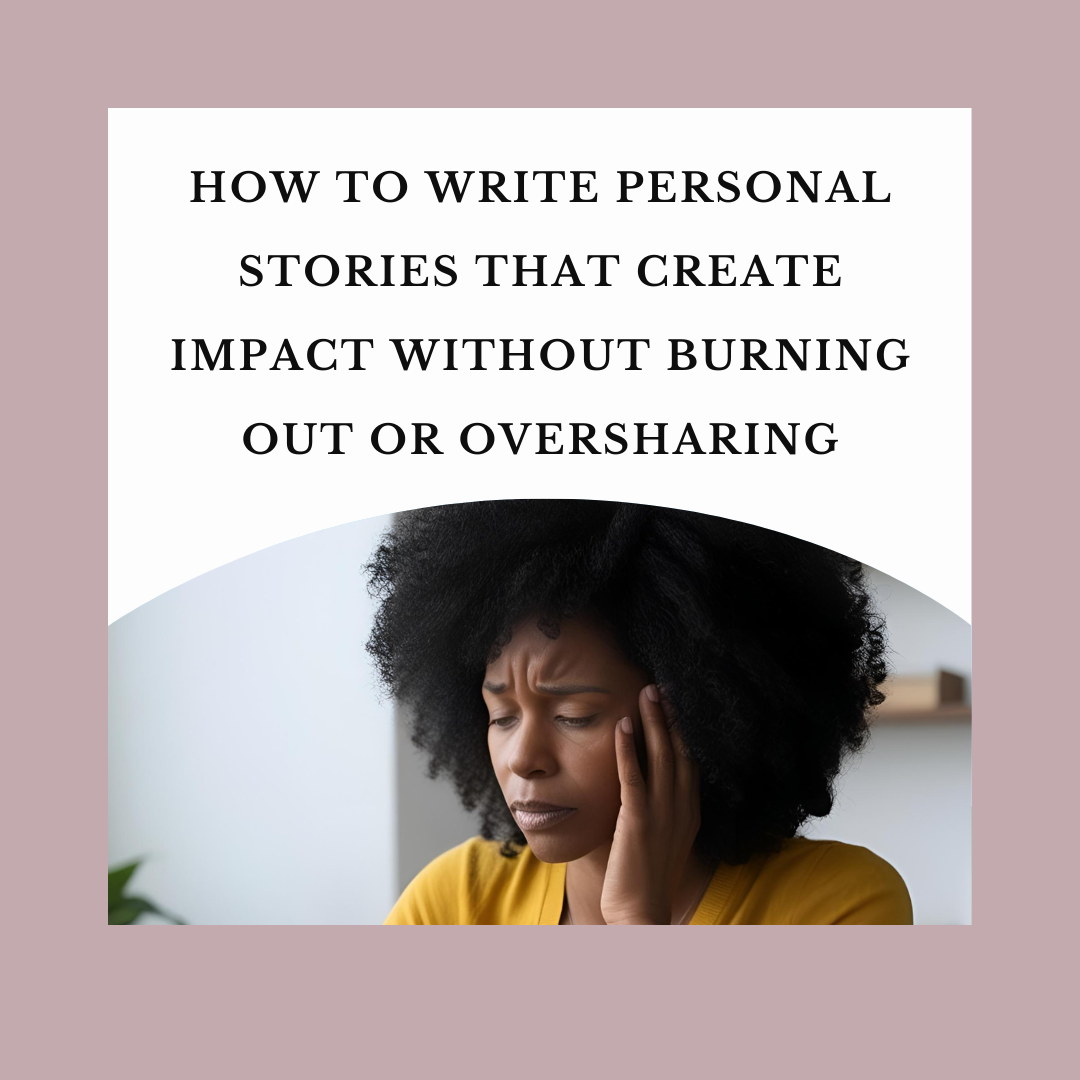
It’s possible to write personal stories that create impact without reopening old wounds or feeling like you’re giving too much of yourself away, but only if you write with purpose and boundaries.
Telling your story can be healing, but it can also leave you emotionally wrecked, vulnerable, or unsure of where the line is. If you’ve ever sat down to write about something real and personal, only to find yourself second-guessing every word, you’re not alone. Whether you’re sharing your lived experiences through memoir or speaking out about injustice through advocacy writing, the emotional weight is real.
You’re not just writing for yourself, you’re holding your story and your reader at the same time. And that’s a lot to carry.
Here’s the thing: you absolutely can tell your truth, make a difference, and still protect your energy. You just need the right strategies.
In this post, I’ll show you how to write personal stories that create impact without burning yourself out or oversharing things that don’t need to live on the page. These are the same techniques I use with clients who are memoirists, advocacy writers, and deeply human storytellers like you.
Why Your Story Matters (Even Without Credentials)
Feel like you’re not “qualified” to speak out? So many memoirists and advocacy writers hesitate because they don’t have a fancy degree, a giant audience, or some kind of official title. But here’s the truth: you don’t need credentials to make an impact; your lived experience is your authority.
If you’ve lived it, witnessed it, or survived it, then you have every right to write about it.

In advocacy storytelling especially, personal truth often hits harder than data ever could. Real stories open eyes, stir emotion, and spark change. They create connections, and they help people feel seen.
But for your story to truly land, intention matters. You don’t need a massive platform to be heard, but you do need clarity.
- Why are you sharing this?
- What do you want your reader to walk away with?
When you understand your “why,” you’ll know exactly how to write personal stories that create impact, stories that stay with your readers long after they’ve finished reading.
The Burnout Risk Is Real, Here’s How to Spot It
Emotional storytelling can feel cathartic… right up until it doesn’t.
Writing about your own experiences, especially if they involve pain, injustice, or trauma, might feel like a release at first. But if you’re not careful, it can turn into something that drains you, mentally, physically, and emotionally. That’s called burnout, and it’s something many personal nonfiction writers face.
Here are a few red flags to watch for:
- You start avoiding your writing sessions completely
- You feel wiped out after just a few paragraphs
- You lose your grip on what your story is about
If any of that sounds familiar, you’re not broken, you’re just burned out.

Here’s the thing: writing your truth should feel powerful. Yes, it might be emotional at times, but it shouldn’t feel like re-living your pain on repeat. If it does, your nervous system is waving a big red flag.
Burnout for writers isn’t a weakness. It’s a message. And the message is: you need better boundaries, more support, and a process that protects your energy.
Knowing when to pause is part of knowing how to write personal stories that create impact, sustainably.
If your writing process leaves you emotionally drained, I’d love to support you with strategies that protect your energy. Book a free consultation to get started.
Start With Purpose: Who Are You Writing This For?
Before you write a single word, pause and ask yourself:
“What do I want my reader to feel, know, or do after reading this?”
This question is everything.
When you’re writing about something personal, especially if it’s heavy or emotionally charged, it’s easy to get swept up in the moment. But if you want to write personal stories that create impact, you need more than raw emotion. You need purpose.
Start by defining the core message of your story in a single sentence. That doesn’t mean summarizing every detail, it means getting to the heart of why this story matters.
For example:
- “This story shows how everyday bias in hospitals affects real families.”
- “This story is for survivors who still don’t feel heard.”
Having that kind of clarity helps you stay focused, protect your energy, and avoid wandering into oversharing. It becomes your North Star.

Quick Exercise:
Fill in the blank: “This story matters because ___________.”
Once you’ve nailed your purpose, everything else becomes easier to write and easier to protect. Because you’re not just processing emotions, you’re sharing something that moves people.
And that’s how you write personal stories that create impact, with intention.
Share from the Scar, Not the Wound
Let’s talk about one of the most important rules in personal storytelling:
Share from the scar, not the wound.
What does that really mean? It means writing from a place of reflection, not crisis. You’ve felt the pain, you’ve lived the story, and now you can look back on it with just enough distance to tell it with clarity.
This is what storytelling with emotional boundaries looks like.
Yes, readers connect with vulnerability. But they also need structure. When your story is still too raw, it can feel overwhelming, for both of you. And let’s be honest: if you can’t edit it without crying or shutting down, it’s probably not ready for the world.
That doesn’t mean your story has to be perfectly resolved. It doesn’t need a “happily ever after.” It just needs to come from a place where you’re safe.
One simple way to check?
Try journaling or voice-noting your story first. Then wait a few days. If revisiting it still feels like ripping something open, it might need more time.

You can write personal stories that create impact without reliving your trauma in real time. Processing first allows you to tell your story from power, not pain.
What to Keep Private (And How to Know)
Here’s a truth most writers learn the hard way:
You don’t have to tell everything to write something powerful.
When you’re writing personal nonfiction, especially memoir or advocacy work, it can be tempting to spill every detail. But that’s where emotional boundaries come in. Boundaries protect your peace, your relationships, and your safety.
Ask yourself as you write:
“Does this part serve the story, or does it just help me unload?”
That simple question can help you avoid oversharing and stay rooted in purpose. If a detail doesn’t move the story forward, reveals a turning point, or offer insight to your reader, it might be better left out, or told in a more contained way.
You don’t have to describe the most painful moment of a breakup to show what you learned from it.
You don’t have to write about every medical incident to speak to systemic injustice.

Try using summary instead of detail for the parts that feel too raw.
Example:
“That year was the breaking point in our relationship”
This can often be more powerful (and less painful to share) than a detailed blow-by-blow of every fight.
Remember: to write personal stories that create impact, you need to stay emotionally grounded. That often means choosing what not to share just as carefully as what you do.
Writing About Other People: Do It Ethically
If you’re writing memoirs or doing advocacy storytelling, this part is huge.
Your story might include other people, family, friends, partners, co-workers, healthcare providers, even entire systems. And while you’re sharing your truth, you’re also handling theirs. That’s where ethical memoir writing becomes non-negotiable.
Before including someone in your story, ask yourself:
- Is this person easily identifiable, even if I don’t name them?
- Is this my story to tell?
- Am I exposing someone who can’t respond, or punching down on someone with less power?
These questions aren’t about silencing yourself. They’re about writing with integrity and avoiding harm. Because yes, honesty matters. But being honest doesn’t mean being reckless.

Here are some tools you can use to write ethically and still stay true to your story:
- Name changes – especially for private individuals not in the public eye
- Composite characters – when multiple people represent one influence
- Content warnings – when you’re writing about sensitive or potentially triggering material
Advocacy storytelling that respects others’ humanity is not only ethical, it’s more powerful. It shows your reader that you’re not just sharing it for attention. You’re sharing for impact, with care.
And that’s what it means to write personal stories that create impact responsibly.
Shape the Story So It Can Hold the Weight
When you’re writing something deeply personal, story structure isn’t just a craft tool, it’s a safety net.
Structure gives your story shape, direction, and flow. More importantly, it helps protect both you and your reader from getting emotionally overwhelmed. Without it, your story can feel like a flood of feelings without a throughline. With it, your message lands with clarity and impact.
Think of structure as a container. It helps you hold the emotional weight of what you’re sharing so that your truth doesn’t spill all over the page, and your reader doesn’t get lost in it.
Here are a few tried-and-true models that work beautifully for emotionally charged or vulnerable content:
- Before → Struggle → Breakthrough
- Wound → Insight → Action
- “This happened, it changed me, here’s what I now know.”
Each of these frameworks gives you a clear path to follow while still honoring the depth of your story.

Not every personal narrative has to follow a strict timeline. But giving your story shape helps you stay focused and helps your readers stay with you, especially when the emotions run deep.
Because when you know how to pace your story and guide your reader through it, you’re not just sharing, you’re showing them how to write personal stories that create impact with intention.
Edit Gently: Build in Recovery and Reflection
When it comes to editing emotional writing, here’s your reminder: this isn’t a race.
Your first draft likely came from a deep, vulnerable place and that means your editing process needs to be gentle, intentional, and kind. This is where self-care for writers becomes just as important as sentence structure.
Start by giving tough sections some breathing room. Don’t go back and read something heavy the same day you wrote it. Let it sit. Let yourself rest. Then return with fresh eyes and a calmer nervous system.

And when you’re ready for feedback? Choose carefully. Invite only trusted readers, those who respect your voice and won’t try to reshape your message to make it more “palatable” or less powerful.
You might also consider:
- Sensitivity readers – to help with identity-related or trauma content
- Trauma-informed editors – who understand how to navigate emotional material
- Peer writers in your niche – who “get it” and offer thoughtful insights
Emotional editing isn’t just about polish, it’s about protection. You’re doing brave work, and that deserves compassion at every stage.
When you edit with care, you preserve the strength of your story and your well-being. And that’s how you write personal stories that create impact, without undoing yourself in the process.
Impact Lives in the Reader’s Experience
You might be the one writing the story, but the moment of impact? That happens in the reader.
Your story is the spark.
The reader creates the fire.
That’s why, when you’re figuring out how to write personal stories that create impact, you have to think beyond the words on the page. Ask yourself:
“What shift do I want this to cause?”
Do you want your reader to feel seen? To understand a struggle they’ve never faced? To take action? To heal?
You’re not just telling your story, you’re guiding the reader through an experience. And for that to work, you have to leave space for them inside it.
That means:
- Writing with clarity, not just emotion
- Offering insights, not just memories
- Leading with intention, not just venting
The most impactful stories are never just about the writer. They invite the reader to see themselves, rethink something, or feel a little less alone.
When you write with your reader in mind, your story becomes more than a reflection, it becomes a mirror, a window, or even a bridge.
And that’s how you create impact that lasts long after the final sentence.
Final Thoughts: Protect the Story. Protect Yourself.
You can write boldly and protect your peace.
In fact, the more personal and powerful your story is, the more you owe it to yourself to build the boundaries that help you stay grounded.
Boundaries aren’t barriers, they’re scaffolding. They support your story, your process, and your emotional well-being. They help you stay honest without feeling exposed, and purposeful without burning out.
Because your voice matters deeply. And so does your energy.
When you learn how to write personal stories that create impact, you’re not just telling the truth. You’re shaping it with care. You’re honoring your experience and guiding your reader at the same time.
So be brave. Be honest. And protect the storyteller in the process.
Talk to a Therapist: Your Mental Health Matters
Telling your story is brave, but it’s also emotional labor. And sometimes, that labor needs professional support.
If your writing brings up unresolved pain, grief, or trauma (and it often will), working with a therapist or counselor can give you tools to process it safely. This is especially true for memoirists and advocacy writers sharing experiences related to abuse, medical trauma, discrimination, or loss.
Consider talking with a mental health professional:
- Before you begin, to check in with your emotional readiness
- During the writing process, especially when tackling heavy chapters
- After sharing your story, to help process any emotional fallout or feedback
A therapist can help you build emotional resilience, set internal boundaries, and stay connected to your purpose without spiraling.
Writing personal stories that create impact doesn’t mean sacrificing your well-being in the process.
Resources to Explore:
Here are a few places where writers can find trauma-informed support:
- Open Path Collective – Affordable therapy options in the U.S.
- Inclusive Therapists – A directory of culturally responsive, identity-affirming mental health professionals
- Therapy for Black Girls – Therapist directory and podcast for Black women seeking care
- Women of Color Remake Wellness: BIPOC Therapists Directory – A curated list of BIPOC therapists who understand the cultural and lived experiences of marginalized communities.
- National Queer & Trans Therapists of Color Network – Directory and resources for QTPOC mental health support
- 7 Cups – Offers free anonymous chat with trained listeners and low-cost therapy with licensed therapists.
If therapy isn’t accessible right now, consider looking for support groups, writing circles, or peer-led spaces where you can safely process your story in community.
Ready to Share Your Story Without Burning Out?
You don’t have to carry the weight of your story alone. If you’re ready to write personal stories that create impact, with clarity, purpose, and emotional safety, I can help you shape your message without losing yourself in the process.
With 1:1 coaching, you’ll get:
- A customized plan to tell your story with structure and intention
- Gentle support and accountability through emotionally heavy content
- Feedback on how to write with ethical boundaries, clarity, and confidence
- A partner who understands the emotional labor behind advocacy and memoir writing
Let’s protect your voice while amplifying your impact.

Leave a Reply