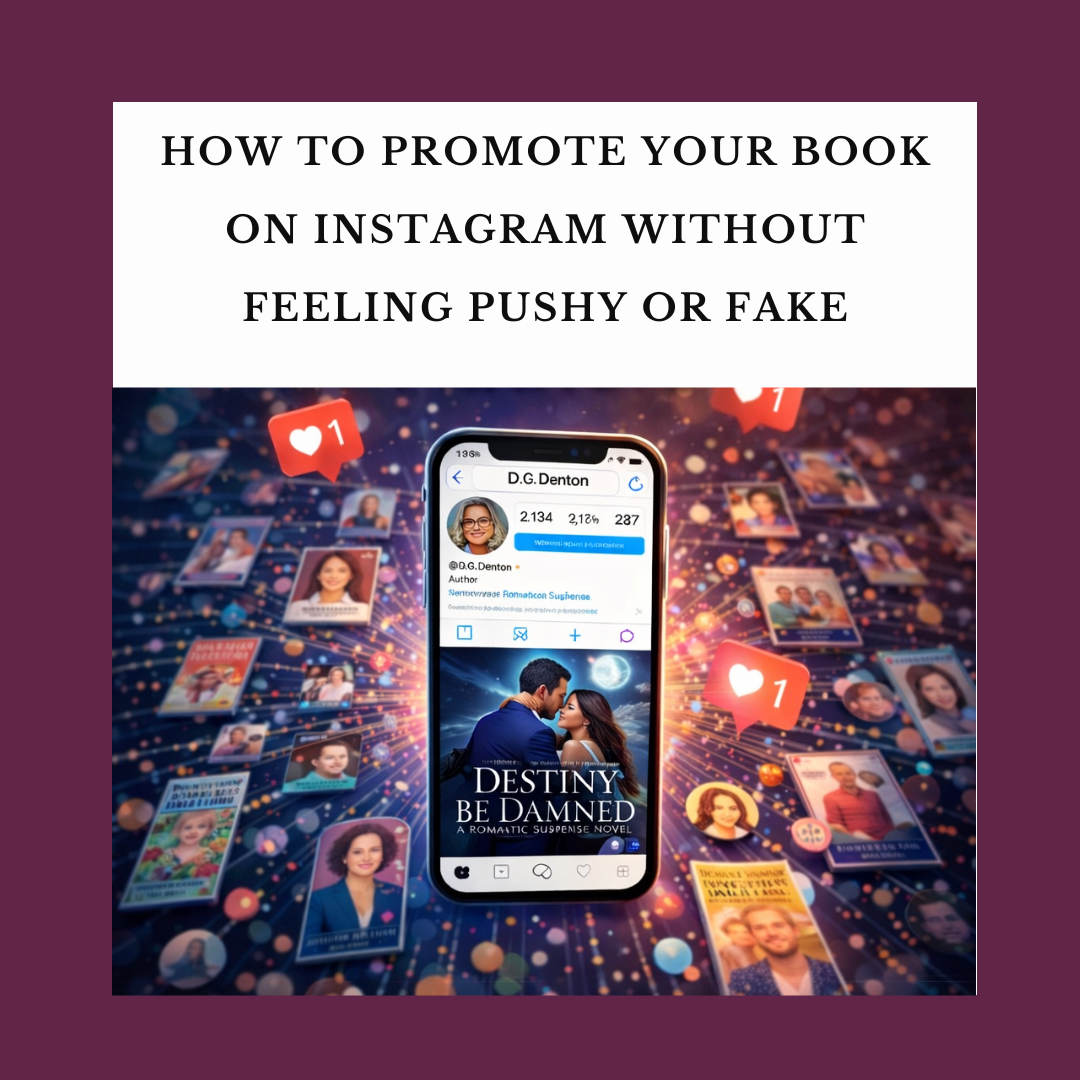
If you have ever wondered how to promote your book on Instagram without sounding pushy, start by giving readers a reason to care before you ask them to buy.
You open Instagram, type “My book is out now,” and stare at the caption box. A few seconds later, it’s gone. Then you try, “I’m so excited to share this book with you,” and delete that too.
The problem is not that you doubt your book. You believe in it, and you want people to read it. You just do not want to sound like a pop-up ad with a cover graphic.
This guide will show you:
- What to post
- How to write captions
- How to use Instagram features
- How to spot what is working
You do not have to post “buy my book” every day to promote well. You need a clear message, a reader-focused reason, and a next step that makes sense.

How Do You Promote Your Book on Instagram Without Feeling Pushy?
Start with the reader’s reason to care, then make the next step clear. The book can still be part of the post, but the post should feel like an invitation instead of a demand.
Promotion Feels Awkward When the Sale Comes First
Picture an author who spent years writing a book, then freezes when launch week arrives. They can write a full chapter, yet one caption makes them feel like they are bragging.
That usually happens when the post starts with the sale instead of the reader. Once the reader comes first, the caption feels more like a useful nudge.
BookBaby’s guide to Instagram book promotion points to author bios, Reels, Stories, launch planning, and reader interaction as useful parts of promotion. Instagram is not just a bulletin board, since readers also notice your tone, book promise, and next step.
Reader-Focused Promotion Gives People a Reason to Care
A weak post says, “My book is out now. Buy it today. Link in bio.”
A stronger fiction post says, “If you love second-chance romance with small-town secrets, complicated family history, and one very inconvenient reunion, this story was written with you in mind.”
A stronger non-fiction self-help post says, “If you keep promising yourself you will slow down but never do, this book gives you small daily practices that fit real life.”
All three posts mention the book. The stronger ones help the right reader see why it might matter, which leads naturally into why plain sales posts often fall flat.
Would it help to have caption starters that already sound natural and reader-focused? Download the free Book Promo Caption Pack for Instagram to make your next promo post easier to writ

Why Do Buy My Book Posts Usually Fall Flat?
Those posts often jump to the ask before they build interest. Most readers need a little context, curiosity, trust, or proof before they click a link.
Weak Posts Skip the Reader’s Reason to Pause
A weak promotional post often leaves out details the reader needs, such as:
- Who the book is for
- What experience or result it offers
- What problem it helps solve
- What makes it different
- What the reader should do next
That is why “My book is available now” usually gets little interaction. It may be true, but it does not tell readers enough.
Each Post Needs One Clear Job
A strong post does one thing well. It can build recognition, explain the promise, show the mood, share proof, start a conversation, or send people to a sample.
BookBub’s Instagram book promotion ideas show publishers using seasonal posts, contests, release posts, blurbs, and creative graphics beyond direct sales.
For fiction, try “This book is for readers who love secret magic, dangerous bargains, and loyalty that comes with a cost.”
For non-fiction self-help, try “This book is for anyone who feels stretched thin and wants a calmer way to care for themselves.”
These examples still promote the book, but they give the reader a doorway before asking for action.
Want more ideas for posts that give readers a reason to care before you ask them to buy? Download the free 50 Instagram Post Ideas for Authors to plan posts that feel useful, clear, and book-focused.

How Can You Make Instagram Book Promotion More Reader-Focused?
Shift the focus from the fact that the book exists to what the right reader will get from it. The mood, topic, promise, problem, or payoff should be easy to spot.
A Reader-Focused Post Starts With Three Details
Before you write the caption, name the reader, the reason, and the next step. Ask who the book is for, what will catch their attention, and what they should do after seeing the post.
For example, “My book is out now” tells readers what happened. “This book is for readers who love haunted houses, family secrets, and twisty endings” tells them why they might care.
Pew Research Center’s Social Media Fact Sheet found that 50% of U.S. adults use Instagram, with higher use among adults ages 18 to 29 and 30 to 49. This matters because your platform should match where your readers spend time.
Genre Examples That Match the Reader’s Need
| Author type | Reader-focused angle | Example post idea |
| Romance author | Trope, emotion, chemistry | If you love forced proximity and emotional slow burn, this scene is for you. |
| Fantasy author | World, stakes, magic, danger | Three things readers should know before entering this kingdom. |
| Thriller author | Tension, secret, danger | The first lie happens on page one. The worst one comes later. |
| Memoir author | Theme, lived experience, change | This story is about grief, identity, and rebuilding when life changes without asking. |
| Self-help author | Reader problem and practical result | This chapter is for anyone who keeps overthinking the first step. |
| Children’s author | Parent, teacher, or child benefit | A read-aloud story for kids who are learning how to name big feelings. |
Vague captions like “Big news coming soon” are not wrong, but they are incomplete. Add the reader reason so the right person knows the news is for them.
Wondering if Instagram is even the right place for your author platform? Download the free Author Instagram Fit Checklist to see if the platform matches your readers, goals, and content style.

What Should You Post Before You Ask Readers to Buy?
Build recognition before the sales ask. Share the book’s mood, message, promise, or purpose so the direct post feels like the next step.
Pre-Launch Posts Warm Up the Reader
| Post type | What it does | Fiction example | Non-Fiction Self-help example |
| Cover reveal | Builds recognition | Meet the cover for my cozy mystery. | Here is the cover for my guide to calmer mornings. |
| Reader hook | Names the right audience | For fans of found family and forbidden magic. | For anyone who wants less stress without a perfect routine. |
| Behind-the-scenes post | Builds connection | The scene that made me rewrite the ending. | The journal prompt that inspired chapter three. |
| Quote graphic | Gives a taste of the book | A short emotional line from a scene. | A practical line or reminder from the book. |
| Concept intro | Creates curiosity | Meet the character who makes every secret worse. | Meet the 3-step reset for overwhelming days. |
| Reader question | Starts conversation | Do you prefer slow burn or instant sparks? | What part of your day feels the most rushed? |
| Sample invite | Moves readers closer | Read chapter one. | Download the reflection page from chapter one. |
Pick the post types that fit your book and your energy. A quiet memoir may not need a countdown, while a self-help book may need practical samples.
A Simple Timeline Keeps Launch Posts From Piling Up
- Six to eight weeks before release, start light awareness posts.
- Three to four weeks before release, share hooks, themes, cover content, and behind-the-scenes notes.
- One to two weeks before release, add preorder reminders, bonuses, questions, and samples.
- During launch week, repeat the ask from different angles.
One post can name the reader, another can share a review, and another can invite people to read a sample. Once readers recognize the book, Instagram features can help you guide them without doing everything.
Need help choosing what to post before, during, and after launch? Download the free Instagram Format Planner for Authors to match each promo moment with the right post format.

How Can You Use Instagram Features Without Trying to Do Everything?
Give each feature one simple job. Reels can introduce the book to new people, Stories can remind warm followers, carousels can teach or explain, and Highlights can keep key details easy to find.
Instagram Creators explains that Feed, Stories, Explore, and Reels are ranked differently, so every format does not need the same kind of post.
Each Feature Works Best With a Clear Purpose
1. Use Reels for quick discovery, such as mood posts, trope lists, quotes, or tips. A self-help Reel might say, “Three signs your morning routine is adding stress.”
2. Use Stories for warm reminders, such as polls, countdowns, link stickers, review screenshots, and launch updates.
3. Use carousels for helpful posts. A fiction carousel might be “Five things to know before reading this series.” A self-help carousel might be “Five small habits that can make bedtime calmer.”
4. Use Highlights for book information, such as Start Here, Books, Reviews, Free Chapter, Events, or Launch Bonus.
5. Use pinned posts for first impressions, including a book intro and a post that tells people where to start.
Video Can Stay Simple
You do not have to dance, lip-sync, or talk to the camera every day. A Reel can use text on screen, book photos, a voiceover, a quote, a page flip, or a simple author tip.
Start with the formats you can repeat. Once your content is easier to manage, it is worth checking whether Instagram can show it beyond current followers.
Want a clear plan for using Instagram without guessing your way through every feature? Learn more about my Author Social Media Strategy Service if you want a strategy built around your books, readers, and time.

Why Should You Check Instagram Account Status and Recommendation Eligibility?
Account health can affect whether public content may be shown beyond current followers. A quick check helps you rule out simple visibility issues before blaming the algorithm.
Instagram says its Recommendation Guidelines help decide what public content can be recommended, and professional accounts can use Account Status to see if content may be ineligible.
Recommendation Eligibility Affects New Reader Discovery
Recommendation eligibility means Instagram may show your public content to people who do not follow you yet. That can include Explore, Reels, Feed recommendations, Search, or Suggested Accounts.
For book promotion, this matters because you usually want more than your current followers to see the post. Your followers are already in the room, while recommendations may help new readers find the door.
A Quick Account Check Keeps the Path Clear
- Check Account Status inside Instagram.
- Check whether any posts are flagged.
- Make sure your profile clearly says what you write.
- Use original posts when you can.
- Make sure your links are safe and working.
- Make sure your calls to action are clear.
Low reach does not always mean something is wrong. After you check account health, look at the post itself and ask whether the right reader had a clear reason to care.
Have questions about whether your Instagram profile is helping or hurting your book promotion? Contact me with any questions, and I can help you sort through what may need a closer look.

How Do You Write Instagram Captions That Sell Without Sounding Salesy?
Start with the reader’s interest, then connect that interest to the book. The caption should make the reader feel seen before asking them to click, save, buy, or sign up.
A Simple Caption Formula Keeps the Ask Natural
1. Hook the right reader. Try “If you love books about complicated sisters…”
2. Name the promise. Try “This story leans into loyalty, resentment, old secrets, and the way family can hurt and heal.”
3. Connect it to the book. Try “That tension is at the center of my new novel.”
4. Give one next step. Try “You can read the first chapter through the link in my bio.”
Fiction and Non-Fiction Captions Need Different Hooks
For fiction, start with the reading experience. A cozy mystery caption might say, “If you love mysteries where every neighbor has a secret, this one is for you.”
For non-fiction self-help, start with the reader’s struggle. A caption might say, “If your mornings feel rushed before you open your eyes, chapter two gives you a five-minute reset.”
Natural Calls to Action Stay Clear
- Read the first chapter.
- Save this for launch day.
- Add it to your TBR.
- Join my reader list.
- Download the free reflection page.
- Comment with your favorite trope.
- Send this to a friend.
- Preorder through the link in my bio.
The best call to action depends on the post. A reader hook might ask for a comment, while a launch post can ask for a preorder.

How Often Should You Promote Your Book on Instagram?
Post often enough that readers remember the book, but not so often that every post sounds the same. A steady mix of reader hooks, proof, reminders, and clear asks feels more natural.
A Weekly Mix Keeps Promotion From Feeling Repetitive
| Weekly post type | Purpose | Fiction example | Non-fiction example |
| Reader hook | Help the right reader self-identify | For fans of enemies-to-lovers with real emotional stakes. | For anyone who wants calmer mornings without waking up at 5 a.m. |
| Behind-the-scenes | Build connection | The scene that almost got cut. | The personal note that became chapter two. |
| Helpful or relatable post | Give value before asking | Three signs this book belongs on your weekend TBR. | Three ways to stop turning self-care into another chore. |
| Social proof | Build trust | A review quote or reader reaction. | A testimonial or reader takeaway. |
| Direct CTA | Ask clearly | Order the book today. | Download the companion reflection page. |
The earlier BookBub author survey reported that 79% of surveyed authors use social media to reach new readers, while 64% use it to build relationships with their biggest fans.
Limited-Time Authors Can Use a Smaller Rhythm
If your week is full, try one feed post, two or three Stories, one direct call to action, and a few short comment-reply sessions.
During launch week, direct promotion can show up more often because there is real timing behind it. Change the angle each day with a release post, reader-fit post, review, behind-the-scenes note, bonus reminder, thank-you post, or email signup post.
Once you have a posting rhythm, the next step is checking whether those posts are doing useful work.
How Do You Know If Your Instagram Book Promotion Is Working?
Look for meaningful actions, not just likes. Saves, shares, comments, profile visits, link taps, email signups, preorders, sales, and reviews tell a better story.
Instagram’s guide to Insights says professional accounts can learn about account performance, content performance, and audience activity.
Useful Metrics Show Reader Interest
- Reach shows how many unique accounts saw the post.
- Saves show that people wanted to come back to it.
- Shares show that someone thought another person would care.
- Comments show that the post started a conversation.
- Profile visits show that someone wanted to learn more.
- Link taps show that the post moved someone toward action.
Monthly Review Turns Numbers Into Better Posts
- Look at your top posts from the last 30 days.
- Write down what those posts had in common.
- Check whether they were Reels, Stories, carousels, or static posts.
- Notice which topics got saves, shares, comments, or link taps.
- Create more posts using the same type of reader hook.
A funny writing meme may get more likes than a sample chapter post. If the sample post gets more link taps, it may be doing more for your book.

Why Should Instagram Lead Readers Somewhere You Own?
Instagram is a starting point, not the whole path. Your website, email list, book page, and reader resources give interested people a next step you control.
A Clear Link Gives Readers a Doorway
Point readers to your author website when they need the full picture. Use your book page when they need details, reviews, formats, retailer links, or sample chapters.
Your email list works best for updates, free chapters, reflection pages, reader magnets, launch news, or behind-the-scenes notes. A retailer page makes sense when your post includes a direct sales ask.
Your Link in Bio Should Be Easy to Understand
- Read the first chapter.
- Join my reader list.
- Preorder the book.
- See all my books.
- Download the free reflection worksheet.
- Get the bonus scene.
- View launch bonuses.
Written Word Media’s 2025 Indie Author Survey found that published authors with an email list earned a median of about $300 per month, while authors without a list earned about $15 per month.
That does not mean an email list guarantees sales. It does show why Instagram should not be a dead end.
Looking for more tools to help you build a stronger author platform beyond Instagram? Check out my other free resources for simple guides, checklists, and templates made for authors.
Final Thoughts
Good promotion helps the right reader understand why your book matters before asking them to act. The next time you freeze over an Instagram caption, start with one better question: What would help the right reader care?
Pick one book, name who it is for, describe the mood or problem, and create one post that gives readers a clear reason to pause. Then add one simple next step.
You do not need to become a full-time influencer to promote your book well. You need a steady rhythm, clear posts, and an easy way to invite interested readers closer.
That is how to promote your book on Instagram in a way that feels clear, useful, and true to the kind of author you want to be.
Would you like help turning your book promotion ideas into a clear plan you can actually follow? Sign up for a free 30-minute video consultation call so we can talk through your next best step.
Want Instagram Captions That Don’t Sound Like Sales Posts?
Grab the free Book Promo Caption Pack for Instagram and turn those awkward “what do I even say?” moments into clear, reader-focused captions you can actually use.
Inside, you’ll get:
- Caption starters for cover reveals
- Preorder and launch-day caption prompts
- Review and testimonial caption templates
- Story prompt ideas for launch week
- Soft call-to-action examples
- A simple promotion mix for before, during, and after launch
Need a Social Media Plan That Feels Like You?
If promoting your book on Instagram still feels scattered, my Author Social Media Strategy service can help you turn random posting into a clear, reader-focused plan that supports your book, your goals, and your energy.
Together, we can map out:
- What to post before, during, and after launch
- Which platforms make the most sense for your readers
- How to create content that sounds natural, not forced
- What calls to action fit your book and audience
- How to build a simple rhythm you can actually keep up with
Instagram Book Promotion FAQs
Can I promote my book on Instagram if I have a small following?
Yes. A small following can still help if the right readers are paying attention. Focus on clear reader hooks, useful posts, and simple calls to action instead of trying to look popular.
Should authors use hashtags when promoting a book on Instagram?
Yes, but hashtags should support the post, not carry it. Use a small mix of genre, reader, and book-related hashtags, such as #CozyMysteryBooks, #SelfHelpBooks, or #Bookstagram, then focus most of your effort on the caption and content itself.
Should I have a separate Instagram account for my author brand?
A separate author account can help if you want a clear space for your books, readers, and writing updates. A personal account can also work if your audience already connects with you there and your content still feels focused.
Can I promote more than one book at the same time?
Yes, but give each book a clear role. For example, promote your newest book directly, then mention related backlist books as “read next” options.
How do I promote an older book on Instagram?
Give the older book a fresh reason to matter. You can tie it to a season, trope, reader mood, anniversary, review quote, book club topic, or current problem your nonfiction book helps solve.
Should I use Instagram ads to promote my book?
Instagram ads can help, but they work best when your book page, cover, description, and target audience are already clear. Test organic posts first so you know which reader hooks get real interest.
How do I get Bookstagrammers or reviewers to notice my book?
Start by finding reviewers who already read your genre. Follow their review rules, interact with their content in a real way, and send a short, respectful request that explains why your book fits their audience.
What should my Instagram bio say as an author?
Your bio should make it easy to understand what you write and where readers should go next. Include your genre or topic, a clear reader promise, and one useful link, such as a free chapter, book page, or reader list.
Can I reuse the same book promotion content more than once?
Yes, but change the angle. Turn one book into several posts by focusing on the cover, a quote, a reader problem, a review, a behind-the-scenes story, or a clear call to action.
What is the biggest mistake authors make when promoting books on Instagram?
The biggest mistake is posting for attention instead of reader action. A strong post should help the right reader understand the book, feel curious, and know what to do next.

Leave a Reply