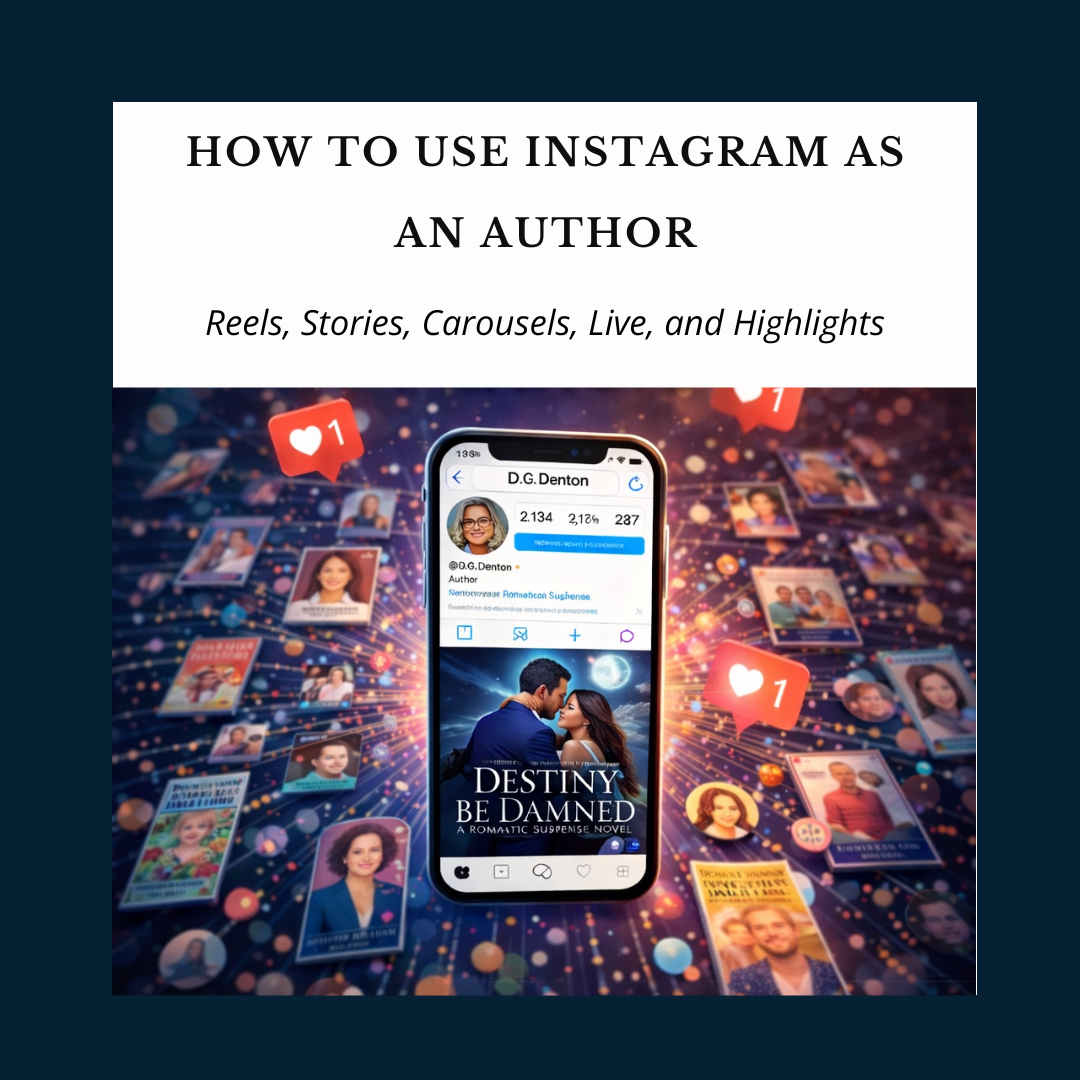
How to use Instagram as an author starts with knowing that not every format does the same job. Some posts help new readers find you, some help current readers stay close, and some make your profile easier to understand.
A lot of authors post again and again, get a few views, and still wonder what any of it is doing. Instagram can look like one giant content pile when you are trying to do everything at once.
It helps to remember that Instagram has different parts, and each one works for a different reason. That matters because the platform still has a huge audience. DataReportal reports that Instagram ads reached 1.74 billion users in January 2025. Pew Research Center also reports that about half of U.S. adults use Instagram.
By the end of this post, you will know which format to use for reach, conversation, teaching, launch support, or a cleaner profile.

How to use Instagram as an author without trying every format at once?
You do not need to use every Instagram format to do well on Instagram. You need to pick the format that matches the job you want the post to do.
What job do you need this post to do?
Start by asking one simple question. What do you need this post to do for you right now?
- Some posts help new readers find you
- Some help you stay connected with current readers
- Some explain one idea clearly
- Some make your profile easier to understand when someone lands on it.
That choice is not just about style. It shapes the result the post is most likely to support. Instagram Creators says different parts of the app use different ranking signals. Feed, Explore, Stories, and Reels do not all work the same way.
That is why this matters so much for authors. A Reel can help with reach. A Story can help with conversation. A carousel can help you teach. A Highlight can help new visitors find what they need.
It also helps to keep this in perspective. Instagram is one part of your author platform, not the whole thing. Your website, email list, and books still matter too.
Where should most authors start?
Most authors can start with one format for getting found, one for staying connected, and one for making the profile more useful. That is enough to build a solid base.
You do not need to master Live first. You also do not need every idea to become a Reel. Start with the content jobs you need most right now.
Want a little more help sorting through all of this? Check out my other free resources for simple tools and guides that can help you build your platform with more clarity and less second-guessing.

What is each Instagram format best at?
Each Instagram format has a main strength. Reels help new people find you. Stories help you stay in touch. Carousels help you teach or explain. Live helps with real-time conversation. Highlights keep useful information easy to find. Once you see that, Instagram feels much easier to use.
What is the quick guide authors can save?
| Format | Best at | Good author examples | Common mistake |
| Reels | Helping new readers find you | Trope hooks, writing clips, mini teasers, quick tips | Trying to teach everything in one Reel |
| Stories | Staying in touch | Polls, countdowns, behind-the-scenes updates, quick check-ins | Expecting Stories to do all the discovery work |
| Carousels | Teaching and explaining | FAQs, lists, book tips, myth vs. truth, launch steps | Stuffing too many ideas into one post |
| Live | Real-time conversation | Launch Q&A, reading, interview, event-style chat | Going Live with no clear reason to show up |
| Highlights | Making your profile clearer | Books, reviews, FAQs, events, freebie info, start here | Letting useful Stories disappear with no system |
Remember: Instagram says Stories disappear after 24 hours unless you add them to Highlights.
- Instagram Help Center also says carousel posts can include up to 20 photos and videos.
- Instagram Help Center says only public accounts with 1,000 followers or more can start a Live broadcast.
- Instagram Creators says Reels up to 3 minutes can be recommended to people who do not follow you.
What do authors get wrong about these formats?
- Reels are useful, but they are not the answer to every content need.
- Stories matter even though they disappear after 24 hours.
- Carousels are not only for designers or influencers.
- Live is useful, but it is not the best starting place for every author.
- Highlights are not just decoration. They help profile visitors understand you faster.
A lot of confusion starts when every format gets treated like it should do the same thing. That is where authors waste time. Reels can help with reach. Stories can build connection. Carousels can slow people down and make one idea easier to follow. Highlights can keep key information on your profile. Live can work well, but only when you have a clear reason to show up in real time.
Want an easy way to keep all of these formats straight? Download the Instagram Format Planner for Authors so you can quickly match each format to the result you want without having to figure it out from scratch every time.

What does this look like for fiction authors and nonfiction authors?
The same formats can work for both fiction and nonfiction authors, but the angle changes. Fiction usually leans more on mood, story, character, and curiosity. Nonfiction usually leans more on teaching, clarity, proof, and trust. That means you can use the same system without copying someone with a very different kind of author business.
What can fiction authors post in each format?
Reels: trope hooks, emotional one-liners, worldbuilding clips, character vibes.
Example: “If you love second-chance romance and family secrets, this one is for you.”
Stories: drafting updates, cover reveal countdowns, polls about characters, quick check-ins.
Example: “Which character would you trust with your secret?”
Carousels: character guides, series recaps, trope slides, and “what to expect” posts.
Example: “5 things to know before you start this fantasy series.”
Live: launch Q&A sessions, short readings, or a reader chat during release week.
Example: a 15-minute live reading on launch day.
Highlights: books, series order, reviews, and events.
Example: one Highlight for each book or series.
This works well for fiction because readers often connect through feeling first. They want a mood, a promise, or a little curiosity before they need more detail.
What can nonfiction authors post in each format?
- Reels: one clear tip, one mistake to avoid, or one myth to correct. Example: “One author platform mistake that wastes your time.”
- Stories: polls about reader struggles, behind-the-scenes work, or short reminders. Example: “What feels harder right now, content or consistency?”
- Carousels: step-by-step teaching, checklists, mini frameworks, or FAQs. Example: “4 steps to make your author bio clearer.”
- Live: Q&A sessions, workshop-style teaching, or an event-based talk. Example: a short live session answering one common question.
- Highlights: start here, resources, FAQs, offers, or client wins. Example: one Highlight for free resources and one for FAQs.
This works well for nonfiction because readers often want help they can use fast. They want clear steps, simple answers, and proof that you understand the problem.
What can both kinds of authors borrow from each other?
Fiction authors can borrow clarity from nonfiction posts. A little structure can make a story-based post easier to follow.
Nonfiction authors can borrow warmth from fiction-style posts. A little story can make helpful advice feel more human and easier to remember.
This matters because the main jobs stay the same across genres. You are still trying to reach people, stay connected, explain something, or help profile visitors find the next step.
Need more ideas that fit the kind of author you are? Download 50 Instagram Post Ideas for Authors so you can come up with content that feels natural for your books, your readers, and your goals.

What is a simple weekly Instagram plan authors can actually follow?
A simple weekly plan works better than trying to post every kind of content all the time. For most authors, one post to help new readers find them, one post to explain or teach, a few Stories, and one quick profile cleanup step is enough to start. That gives you a plan you can actually use.
What is a good one-week plan?
- Monday: Post one Reel. Use it to help new readers notice you. Example: a trope hook, mini tip, or quick writing clip.
- Tuesday or Wednesday: Share 3 to 5 Story slides. Use them to stay in touch. Example: a poll, a question sticker, or a behind-the-scenes update.
- Thursday: Post one carousel. Use it to explain one clear idea. Example: “5 things to know before reading my series” or “3 mistakes new writers make on Instagram.”
- Friday: Save one useful Story into a Highlight. Use it to make your profile more useful. Example: a FAQ, launch reminder, review, or freebie.
- Once a month: Consider Live if it fits your stage. Use it for a clear event moment, not just to check a box.
This kind of mix makes sense because Instagram uses different signals across different surfaces. Instagram Creators explains that the app does not rank everything the same way. One format does not do every job equally well.
How can one idea become more than one post?
One strong idea can do more than one job. You do not need a brand-new idea for every post.
Let’s say you write a blog tip about making your author bio clearer. That same tip can turn into several pieces of content.
The main steps can become a carousel. The strongest line can become a Reel hook. One question can become a Story poll. The best Story answer can be saved to a Highlight.
That kind of reuse keeps your week simpler. It also helps your content feel connected instead of scattered.
Want help turning this into a real plan for your own platform? Learn more about my Social Media Strategy service for authors if you want a clearer, more personalized approach to planning content and connecting with readers.

What should you track for each Instagram format?
You should track the result that matches the job of the format. A Reel should not be judged like a Story, and a Story should not be judged like a carousel. That one shift can save a lot of frustration.
What is the simplest metric checklist?
- For Reels, watch reach, plays, shares, and profile visits.
- For Stories, watch replies, poll taps, sticker taps, and exits.
- For carousels, watch saves, shares, comments, and reach.
- For Live, watch live viewers, comments, and replay views.
- For Highlights, watch profile actions, link clicks, and whether common questions slow down in your DMs.
Instagram says you can view insights for specific posts, Stories, Reels, and Live videos. Instagram Help Center explains how those insights work.
What counts as a win for each format?
A Reel is a win when it helps new people find your profile. It does not need to be your most liked post.
A Story is a win when readers reply, vote, or tap a sticker. That shows people are paying attention.
A carousel is a win when people save it or share it. That usually means the post was clear and useful.
A Live is a win when it creates real back-and-forth conversation. The goal is connection, not just showing up.
A Highlight is a win when a profile visitor quickly sees where to go next. That could mean your books, FAQs, or events.
Still not sure which numbers are actually worth watching? Contact me with any questions, and I can help you focus on the metrics that make the most sense for your goals instead of getting lost in all the data.

What usually makes Instagram feel harder than it needs to?
Most authors do not get stuck because Instagram is too complex. They get stuck because they expect one format to do every job. That makes the platform feel confusing fast.
The easier path is to stop asking, “What should I post today?” Start asking, “What do I need this post to do?”
What mistakes cause the most confusion?
- Using one format for every goal. A Reel can help new readers find you. It is not the best tool for every update or lesson.
- Treating Stories like they should bring big reach. Stories work better for quick connection. They are strong for touchpoints, not broad discovery.
- Trying to teach too much in one post. Carousels work best when they explain one clear idea at a time.
- Ignoring Highlights. Useful Stories should not always disappear. Highlights can help new profile visitors find books, FAQs, reviews, or event details faster.
- Thinking Live is the first thing to master. Live can be helpful, but it is not the best starting point for everyone.
When you match the format to one clear job, the platform gets simpler fast. You can stop posting just to keep up and start posting with a reason.
Wondering if Instagram is even the right fit for you right now? Download the Author Instagram Fit Checklist to help you think through whether this platform makes sense for your stage, your writing life, and the kind of audience you want to reach.

What should you do next?
How to use Instagram as an author gets easier when you stop asking one format to do every job. Pick one goal, choose the format that fits it, and build your plan from there. That is how the platform starts to feel useful instead of overwhelming.
Step 1: Look at your last nine posts
Pull up your last nine Instagram posts. If you have not posted yet, list your next nine ideas. Do not judge the posts yet. Just look at them as a group.
Step 2: Give each post one clear job
Label each post with one main job. Use these labels: help new readers find me, stay connected, explain something, support a launch, or make my profile easier to understand. Only pick one label per post. That keeps things simple and honest.
Step 3: Notice what is missing
Now look for gaps. You may see plenty of posts that teach, but none that help new readers find you. You may see Reels and carousels, but no Stories that keep readers close. You may also notice that your profile does not explain your books, your series order, or your next step.
Step 4: Make one small fix for next week
Do not rebuild everything at once. Fix one gap first. If you need more reach, plan one Reel. If you need more connection, plan three to five Story slides. If you need more clarity, plan one carousel. If your profile feels messy, save one useful Story to a Highlight. That gives you a simple plan you can actually follow.
Step 5: Use one tool to map it out
The Instagram Format Planner for Authors can help you sort your posts by job. It includes a format chart, a purpose guide, post prompts, a weekly planner, a metric tracker, and a Highlight planner. Start there, then adjust as you go. You do not need a perfect system. You need one that makes your next post easier to choose.
Want help figuring out what your next step should be? Sign up for a free 30 minute video consultation call if you’d like space to talk through your platform, your questions, and what would make the most sense for you right now.
Want a simpler way to choose the right Instagram format?
If Instagram feels confusing, this planner helps you stop guessing. You’ll be able to match the right format to the result you actually want from your post.
What’s inside:
- A format comparison chart
- A purpose-to-format matching guide
- Post idea prompts for Reels, Stories, carousels, Live, and Highlights
- A simple weekly content mix planner
- A metric tracker by format
- A profile Highlight planning section
Need a social media plan that fits your books, your readers, and your schedule?
Trying to figure out Instagram on your own can get messy fast. My Social Media Strategy for Authors service helps you build a clear plan based on your goals, your audience, and the platforms that make the most sense for your work.
What this service helps you with:
- Reviewing your current social media presence and audience
- Choosing the best platforms for your genre, goals, and content style
- Building a content strategy tailored to each platform
- Planning a posting rhythm you can actually keep up with
- Learning better ways to engage with readers and grow real connection
- Getting guidance and follow-up support as you put the strategy into action
Instagram Questions Authors Often Ask
Should authors use a personal account or a professional account on Instagram?
If you want to grow as an author, a professional account is usually the better choice. Instagram says professional accounts give you access to tools that help you grow, understand your audience, and use the Professional Dashboard. If you only use Instagram to stay in touch with friends, a personal account is still fine.
Should an author account be public or private?
If your goal is new-reader discovery, keep your account public. Instagram says public posts with hashtags can appear in hashtag search results, and people can search Instagram using keywords to find accounts, posts, hashtags, audio, tags, and places. A private account can still work for a close community, but it is a poor fit for reach.
Do hashtags still matter for authors?
Yes, but they work best as support, not as your whole strategy. Use a small set of specific hashtags that match your book, genre, topic, or audience. A fantasy author might use tags tied to fantasy readers or worldbuilding, while a nonfiction author might use tags tied to their subject or reader problem. Instagram says hashtags can place public posts into corresponding search results, which is why relevance matters more than stuffing in random tags.
What should authors pin at the top of their profile?
Pin the posts that help a new visitor understand you fast. A fiction author might pin a “start here” post, a newest-book post, and a series-order post. A nonfiction author might pin an intro post, a strongest teaching post, and a post that explains who the content helps. Instagram lets you pin posts to the top of your profile, so use that space on purpose.
Are Collab posts worth using for authors?
Yes, when both audiences make sense together. Instagram says you can invite another account to collaborate on a post or Reel, which lets the content live on both accounts. Fiction authors can use this with cover designers, narrators, bookstores, or book reviewers. Nonfiction authors can use it with podcast hosts, experts, event partners, or clients.
How can authors tell whether their content can still be recommended?
Check your Account Status. Instagram says you can use Account Status to see whether something you posted may affect recommendation eligibility, and professional accounts can check whether content may be eligible to be recommended. This is one of the first places to look if your reach suddenly drops and nothing else has changed.
Why does a post sometimes not show up in Explore or search even when it seems good?
Because good quality alone does not guarantee wider distribution. Instagram says not all posts or accounts are eligible to appear in Explore and search results. If an account recently had content issues, or a post is not eligible for recommendation, reach can stay limited even if the post itself feels solid. That is why checking Account Status matters.
Should authors write alt text for image posts?
Yes, especially if you post quote graphics, infographics, book covers, teaching slides, or visual mood boards. Instagram says it uses automatic alt text for photos, and it also lets you edit alt text yourself. That gives you a chance to make the post more accessible and more understandable for people using screen readers.
What should authors do about spammy or rude comments?
Do not treat comment problems like something you just have to live with. Instagram says you can turn comments off on a post, pin positive comments, and restrict accounts. For authors, that usually means you can keep discussion open on most posts, then tighten things up fast when a launch post, ad, or viral Reel starts attracting junk.
Are trial Reels worth testing?
Yes, if the feature is available to you and you want to test a new style with less pressure. Instagram introduced trial Reels so creators can try content with non-followers first and see what performs best before sharing it more broadly. That can be useful for fiction authors testing a new hook style and for nonfiction authors testing a new teaching angle.

Leave a Reply