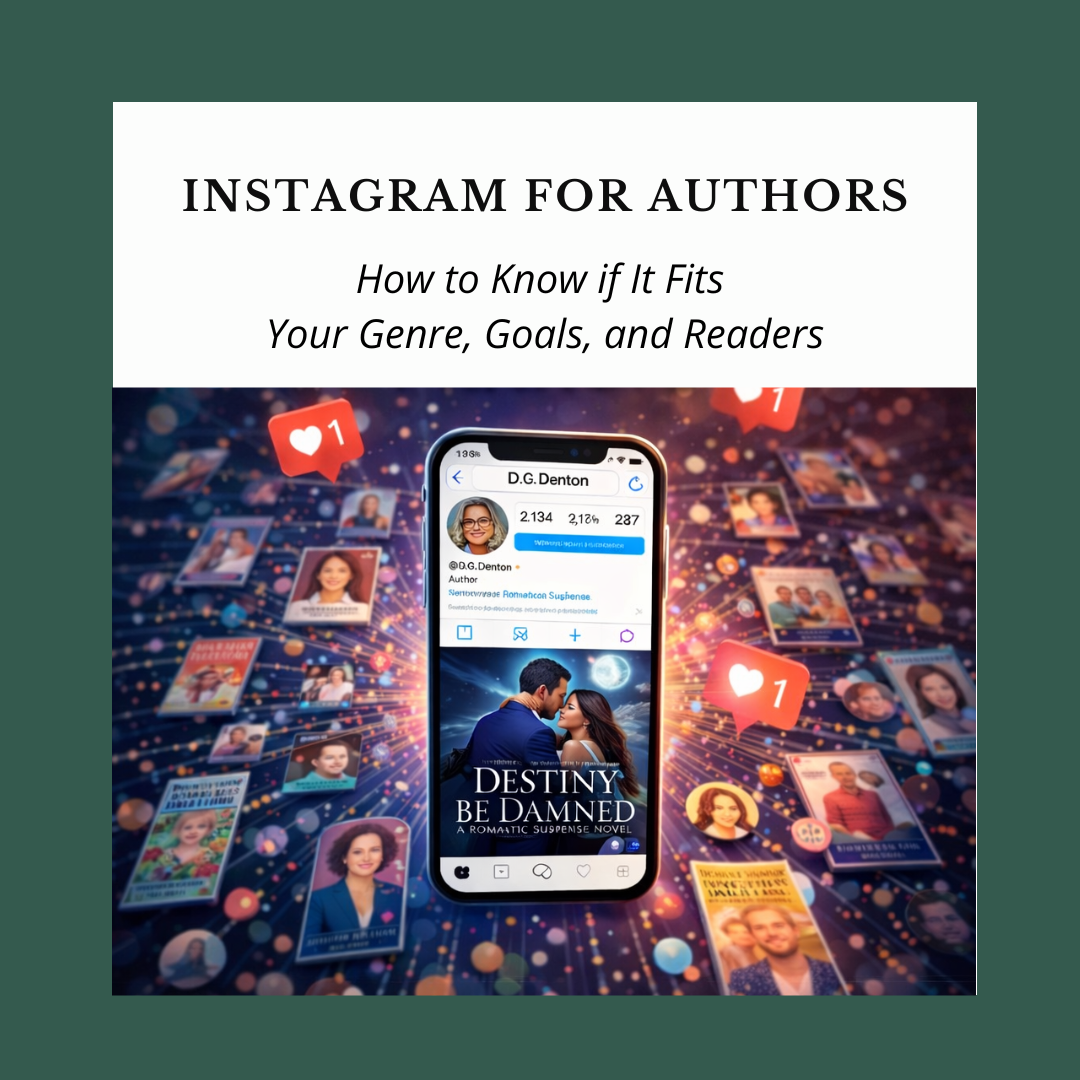
Instagram for authors can be useful. It can also turn into one more thing on your to-do list that eats time and leaves you wondering if any of it matters.
A lot of writers open the app, see polished feeds, clever reels, and pretty book photos, and start thinking they are already behind.
BookBub’s 2025 survey of 850+ authors found that more than 78% use at least one social platform at least weekly, and 51% said they use Instagram at least weekly. So yes, a lot of authors are there. That still does not mean Instagram is the right move for every author.
This post will help you sort that out. By the end, you should know whether Instagram belongs in your platform as a primary channel, a secondary one, or not high on the list right now.

Do authors really need Instagram?
No, not automatically. Some authors do really well on Instagram. Others get more traction from a website, an email list, a blog, LinkedIn, YouTube, or another place that fits their readers better.
What matters most is not whether Instagram is popular. What matters is whether it helps the right readers find you, remember you, and stay connected to your work.
Why does Instagram feel like a requirement?
A lot of writers look around, see other authors posting on Instagram, and start thinking, “Well, I guess I need to be there too.”
That is an easy trap to fall into. When something is common, it starts to feel required. Visibility can look like proof, even when it is not a real fit.
A platform can be popular and still be the wrong choice for your genre, your audience, or your energy.
What do authors actually need more than a social account?
Authors need a clear platform. Readers should be able to tell who you are, what you write, and why they should care.
They also need a way to find you again and a way to hear from you again. That is where your home base comes in. Reedsy’s email list guide makes this point well: your mailing list is under your control in a way social platforms are not. Your website and your email list give readers a clear place to land and a clear way to stay connected.
A writer can post every day on Instagram and still feel stuck if the message is fuzzy, the website is confusing, or there is no next step for the reader.
What is the smarter question to ask?
A better question is this: what job would Instagram do in your platform?
Would it help people discover your books? Keep readers warm between launches? Support your newsletter or your website? Once you ask that, the whole conversation gets a lot clearer.
Example:
A fiction author keeps thinking Instagram is the thing holding them back, but when they look closer, their website still does not clearly say what kind of stories they write or who the books are for.
A nonfiction author has the same feeling, but the real issue is that their site does not clearly explain what they help readers do, and there is no simple path to join the email list. In both cases, the missing piece is not Instagram. It is clarity.
What can Instagram help authors do, and where does it fall short?
Instagram can help authors get discovered, stay recognizable, and keep a light connection going with readers. It cannot replace your website, your email list, or your full platform strategy.
What does Instagram do well?
- Help readers discover you through search, profile text, captions, and hashtags.
- Keep your name and books visible between launches.
- Give readers quick ways to interact through Stories, comments, replies, and DMs.
- Support visual branding, especially when mood, genre, voice, or aesthetics matter.
- Give you short-form ways to talk about your work without writing a full blog post.
Instagram’s own search guidance says search looks at things like account text, captions, hashtags, and places. That is why a clear bio and clear captions do more for you than vague one-liners.
- Where does Instagram fall short for authors?
- It does not give you full ownership of your audience.
- It does not guarantee sales.
- It can make busywork feel productive, even when no one moves to your site, your list, or your books.
- It can create pressure to make more content than you really need.
- It can blur the line between engagement and real business results.
Instagram for Creators also points out that you can break down reach by followers and non-followers. That is useful because it helps you see the difference between visibility and actual movement.
What job should Instagram do in an author platform?
Instagram works best when it has a clear job.
That job might be discovery. It might be reader warmth. It might be launch support. It might be a gentle push toward your website, your email list, or your book page.
Example:
A fiction author gets decent engagement on teaser quotes, character posts, and mood boards, but the real reader trust keeps growing through their email list and website.
A nonfiction author sees the same pattern with helpful quote posts and short tips. Instagram keeps both authors visible, but the deeper connection still happens through the blog, website, and email list. Instagram supports the platform. It does not carry the whole thing.
Still trying to figure out what your platform actually needs most right now? Check out my free resources for practical help with building an author platform that makes sense for your goals, readers, and stage of business.

Which fiction and nonfiction authors are the strongest fit for Instagram?
Instagram tends to be a stronger fit for authors whose readers respond well to visual, emotional, or short-form content. It tends to be a weaker lead platform for authors whose best content is long-form, search-based, or heavily teaching-driven.
| Author type | Likely fit | Why it can work | Content examples |
| Romance, romantasy, YA, women’s fiction | Strong | Readers often respond to mood, tropes, quotes, characters, aesthetics, and fast emotional hooks | trope posts, teaser quotes, mood boards, reader polls |
| Children’s author or illustrator | Strong | The work is naturally visual | art snippets, page spreads, school visit photos |
| Lifestyle, faith, wellness, or personal-growth nonfiction author | Moderate to strong | Visual tips, personal voice, and community-style content often work well | mini tips, reflection captions, carousel takeaways |
| Business, educational, or thought-leadership nonfiction author | Moderate | Instagram can support visibility, but deeper trust often grows better through blog, email, or LinkedIn | myth-busting posts, short teaching clips, newsletter invites |
| Literary or essay-driven author | Mixed | Fit depends more on audience habits and author voice than on aesthetics alone | short reflections, line excerpts, behind-the-scenes process |
| Very time-strapped author | Mixed to weak | Instagram can become draining if it needs more content than the author can sustain | simple updates, launch support only |
This is not a rulebook. It is a fit guide. Pew says half of U.S. adults use Instagram, with usage much higher among younger adults. BookBub’s2025 survey also found that Instagram was the second most popular platform across genres, with especially strong use among authors in women’s fiction, romance or rom-com, and Christian fiction. So, audience age and genre culture are both useful clues, but neither one tells the whole story by itself.
What audience clues matter most?
- Age range. Younger readers are more likely to be there, but age alone does not decide the whole thing.
- Genre culture. Some reader spaces love quick, visual, bookish content. Others lean more toward blogs, podcasts, newsletters, or LinkedIn.
- How visual the reader space is. If readers respond to mood, art, aesthetics, and short emotional hooks, Instagram may fit better.
- Whether readers like quick updates or deeper content. Some want short check-ins. Others want longer teaching or reflection.
Why does this section matter?
This keeps the post from sounding like one-size-fits-all advice. It helps fiction and nonfiction authors both feel seen, and it sets up the next step: deciding whether Instagram should be primary, secondary, or optional for you.
Not sure whether Instagram fits your genre, your readers, or your content style? Download the Author Instagram Fit Checklist to help you sort out whether Instagram should be primary, secondary, or optional for you.

How do you decide whether Instagram should be primary, secondary, or optional?
Instagram should be primary when it clearly matches your readers and your strengths, secondary when it helps but should not lead your strategy, and optional when it does not fit your audience, your content style, or your time right now.
Step 1, what is your real goal?
- Discovery. Instagram can be strong here.
- Reader connection. It is good at light, ongoing contact.
- Launch support. It can help with reminders, reveals, and quick updates.
- Newsletter growth. It can point readers to your list, but it is not your list.
- Direct sales. This is where many authors expect too much. Instagram is usually better for discovery and connection than for direct sales.
- Networking with other authors. This can be a real benefit too.
BookBub found that authors most often use social media to reach new readers, build relationships with their biggest fans, and connect with other authors. That is a good clue about what social media is best at doing.
Step 2, where are your readers already paying attention?
- What age range are they in?
- Do they spend time in bookish or visual spaces?
- Do they respond to short, conversational content?
- This step is about watching reader habits, not copying other writers.
Step 3, what kind of content can you keep making without resentment?
- Photos or graphics
- Short videos
- Captions with personality
- Stories and quick updates
- Simple repeatable formats
- If the content itself already feels like a fight, that matters.
Step 4, what can you realistically maintain each week?
- How many posts?
- How many Stories?
- How much time do you have to reply to people?
- How much time do you have to review what is working?
BookBub’s survey shows that social media still takes time. More than 90% of authors in the survey spent at least a few hours a month creating social posts. So even a casual test still costs time and attention.
| If this sounds like you… | Instagram should probably be… |
| Your readers are active there, your content translates well, and you can post consistently without dread | Primary |
| Your readers are there, but another channel does more of the heavy lifting | Secondary |
| Your readers are elsewhere, or the content style feels like a constant fight | Optional |
Example:
A fiction author keeps trying to make Instagram the main driver of book sales, but the best response keeps coming from newsletter updates, launch emails, and reader follow-through on the website.
A nonfiction author keeps pushing Instagram too, but the strongest traction comes from blog posts, emails, and speaking. Once both authors stop expecting Instagram to do the heavy lifting and start treating it as a secondary channel, the whole strategy feels lighter and works better.
Want help choosing the right role for Instagram in your overall platform? Learn more about my Social Media Strategy for Authors if you want a plan built around your books, your audience, and the platforms that fit you best.

What if you hate video, do not have a book out yet, or barely have any time?
You can still use Instagram in a low-pressure way, and in some cases you may be better off keeping it secondary for now. You do not need a published book, daily posting, or constant video to make a smart platform choice.
What if I hate being on camera?
- A camera-heavy strategy is not the only strategy.
- Carousels, graphics, captions, Stories, quotes, and still images can still do useful work.
- The bigger question is whether the platform fits at all, not whether you can copy creators.
This matters because BookBub found that over half of surveyed authors spend no time making videos for social media. So if video is not your thing, you are not automatically disqualified.
What if I do not have a book out yet?
- Pre-published authors can still build familiarity.
- This works best when the platform lines up with future readers and the author’s message.
- Over time, the account should point toward a website, a waitlist, or an email sign-up.
Reedsy’s current social media guide takes the same basic view: pick the platforms that fit you and your audience, then tailor the way you use them.
What if I only have a little time?
- Secondary is a valid choice.
- One to two posts a week can be enough for a real test.
- Consistency matters more than volume when you are checking fit.
What if Instagram makes me feel guilty?
- Guilt is not a strategy signal.
- Pressure from other authors does not prove reader fit.
- Choosing not to prioritize Instagram can be a smart business decision.
Example:
A fiction author keeps telling themselves, “Real authors do video,” but then notices that quote posts, launch updates, and thoughtful captions get better response than reels ever did.
A nonfiction author has the same realization when simple teaching posts and newsletter emails connect better than trying to be on camera all the time. That is the moment Instagram stops feeling like a guilt machine and starts becoming a support tool, or a lower priority.
Feeling stuck because social media keeps raising more questions than answers? Contact me if you have questions about what makes sense for your platform, your schedule, or your next step.

What should you post if Instagram is a fit?
Post content that helps readers recognize you, connect with your work, and take one simple next step. You do not need endless ideas. You need a small set of repeatable content pillars that match your brand, your readers, and your time.
Clear captions matter. Instagram says search looks at things like account text, captions, and hashtags, so simple, specific wording will usually do more for you than vague one-liners.
What content pillars make sense for fiction authors?
- character or world-building teasers
- trope posts
- quote graphics
- mood boards
- cover reveals
- behind-the-scenes writing life
- reader questions and polls
- review highlights
Example:
A fiction author, like a romance writer, could rotate three simple pillars: trope graphics, cozy writing-life posts, and reader poll Stories.
What content pillars make sense for nonfiction authors?
- short teaching points
- myth-busting carousels
- quick lessons from lived experience
- client-safe behind-the-scenes insights
- quote cards from your message or book
- invitations to a blog post, free resource, or newsletter
Example:
A nonfiction author could do the same kind of simple rotation with quick teaching posts, myth-busting carousels, and one weekly post that points readers to a blog article or freebie.
What content pillars work for almost any author?
- personal-but-bounded updates
- FAQ posts
- “what I’m working on” posts
- event reminders
- newsletter invites
- seasonal or launch updates
- reader conversation prompts
These kinds of posts work because they are simple, flexible, and easy to repeat.
What should a simple weekly rhythm look like?
- 1 value post
- 1 connection post
- 2 to 4 Stories
- 1 movement post that points to your website, your list, or your book page
That is enough for most authors. The goal is not to impress people with volume. The goal is to give readers a clear reason to notice you and a clear next step when they do.

How should you test Instagram for 90 days without wasting time?
Test Instagram for 90 days by choosing a small set of content pillars, posting on a manageable schedule, and tracking whether the platform helps your real goal. A useful test is about evidence, not vibes.
A good test is small on purpose. You are not trying to become an Instagram personality in three months. You are trying to see whether this platform earns a real place in your strategy.
What should you set up before the test starts?
1. Define one main goal.
2. Tighten your bio.
3. Make sure your profile link goes somewhere useful.
4. Choose 3 content pillars.
5. Choose a posting rhythm you can actually keep.
Instagram for Creators says Insights can help you track growth, engagement, and reach. That is why a clear goal matters before you start posting.
What should you track during the test?
1. reach
2. non-follower reach
3. profile visits
4. website clicks or link taps
5. replies, comments, shares, and saves
6. email sign-ups or traffic spikes after Instagram activity
Instagram for Creators also says you can break down reached accounts by followers and non-followers. That makes it easier to see whether people who do not already know you are starting to find you.
What counts as a win?
- more non-followers are finding you
- profile visits rise after strong posts
- readers click through to your site or list
- conversations increase
- content creation feels more sustainable, not more chaotic
What are the signs Instagram should stay secondary or optional?
- nothing meaningful moves after a fair test
- your readers respond better on other channels
- the content style always feels forced
- the time cost is too high for the return
Example:
A fiction author stops obsessing over follower count and starts paying attention to profile visits, book-page clicks, and newsletter sign-ups after launch posts.
A nonfiction author makes the same shift by watching site traffic, email sign-ups, and clicks to a blog post or free resource. That is when the test starts to make sense, because Instagram is finally being judged by what it helps move.
90-day test checklist
- one clear goal
- a bio that says who you are and what you write
- a profile link with a real next step
- three repeatable content pillars
- a posting rhythm you can keep
- weekly check-ins on reach, non-follower reach, clicks, and conversation
- a final decision: primary, secondary, or optional
Want to talk through your platform choices before you spend the next 90 days testing the wrong thing? Sign up for a free 30-minute video consultation call so we can look at what fits your goals, readers, and content capacity.
Final Thoughts
Instagram is worth your time when it supports your bigger platform, reaches the readers you actually want, and fits the kind of content you can keep making without burning out. If it does not do those things, it is completely fine for it to stay secondary, or to stay off your priority list for now.
Choose one label: primary, secondary, or optional. Then act on that label. If Instagram has a clear job in your platform, give it a simple 90-day test. If it does not, put your next block of energy into something you own, like your website, your email list, or a reader freebie.
A smaller strategy that fits your readers will almost always do more for you than a bigger strategy that leaves you tired and second-guessing everything.
Want to know if Instagram is actually worth your time?
Download the Author Instagram Fit Checklist to figure out whether Instagram should be a primary part of your platform, a secondary support tool, or optional for now.
- a platform-fit checklist
- a reader-location assessment
- a genre-and-content alignment worksheet
- a simple decision guide: primary, secondary, or optional
- a 90-day test planning section
- a short metrics tracker for reach, profile visits, and website taps
Need a social media plan that actually fits your author platform?
If Instagram is not the whole answer, the next step may be a strategy built around your goals, your readers, and the platforms that make the most sense for your books. Darla’s Social Media Strategy for Authors is designed to help authors build real visibility and reader connection with a plan tailored to their voice, audience, and content style.
- a review of your current social media presence and audience
- help choosing the best platforms for your genre and goals
- a content strategy tailored to each platform
- guidance on posting rhythm and scheduling
- engagement ideas to help you build stronger reader connection
- follow-up support as you put the plan into action
Instagram for Authors FAQ
What is Bookstagram, and should authors be part of it?
Bookstagram is the book-focused corner of Instagram where readers, reviewers, creators, and authors share book content. It can be useful for authors who want to meet active readers, especially in visually strong genres, but it works best when you treat it as a community, not just a promo channel.
Should authors use a creator account or a business account on Instagram?
Most authors will do well with a professional account, since Instagram says professional accounts give access to tools for growth, ads, monetization, and performance tracking. Instagram also says creator accounts are designed for public figures, artists, content producers, and influencers, which makes creator accounts a natural fit for many author brands.

Leave a Reply