
BookTok strategy for authors starts with one clear goal: help readers understand what kind of book you wrote within seconds.
TikTok moves quickly, and viewers decide in seconds whether to keep watching. You don’t need to perform or compete with high-energy creators. What matters is whether your video clearly shows the experience your book offers.
Videos are distributed based on how people respond to them. Watch time and engagement carry more weight than follower count. That means clarity consistently outperforms noise.
In this post, you’ll learn how to build a BookTok strategy for authors that fits your genre, your comfort level, and your stage of publication. We’ll look at how fiction and nonfiction differ, how to choose a format you can sustain, and what real success looks like on the platform.
Let’s break it down.

What does a BookTok strategy for authors actually involve?
Before you post anything, you need to make three clear decisions: who your book is for, how you will show that in a short video, and what you want each video to accomplish.
TikTok is a viewer platform. According to Pew Research Center 37% of U.S. adults use TikTok, and many of them watch videos without posting their own. That means you are speaking to readers, not creators.
Your job is not to impress other authors. Your job is to help the right reader quickly recognize that your book fits what they already enjoy.
When your videos clearly signal genre, tone, or outcome, the platform has an easier time placing your content in front of people who engage with that type of material. When your content is vague, the system has less information to work with.
A strong approach usually includes three parts.
1. Reader signal
A reader signal is a fast clue about the experience your book offers.
It might be a trope.
It might be a clear genre label.
It might be a specific result for nonfiction.
For example:
“Enemies to lovers.”
“Small-town murder mystery.”
“How to stop making the same mistakes.”
These signals help a scrolling viewer decide within seconds whether to keep watching.
2. Format fit
Format fit means choosing a style you can repeat without stress. Some authors prefer speaking directly to the camera. Others prefer text on screen, slideshows, or voiceover.
The best format is not the most dramatic one. It is the one you can maintain every week. If filming feels draining, you will avoid it. Consistency matters more than intensity.
3. Career alignment
Your content should also match your current stage as an author.
- If you do not have a book out yet, focus on building recognition and genre clarity.
- If you just launched, repeat your strongest hook so more readers see it.
- If you have several books, bring older titles back into view and show new readers where to start.
When these three parts work together, your content stops feeling random. You know what you are signaling, how you are presenting it, and why you are posting it.
That structure is the foundation of a strong BookTok strategy for authors.
Feeling unsure how to pull all three pieces together for your own book? Download the Build Your BookTok Strategy guide to map out your reader signal, format fit, and career alignment in one simple worksheet.

Will BookTok work for your genre?
Every genre can work on BookTok, but success depends on how clearly you communicate the experience your book offers.
People scroll quickly. They are not searching for “a new author to support.” They are reacting to specific emotional cues and specific outcomes. If your video makes that experience obvious right away, it has a much stronger chance of reaching readers who already enjoy that type of book.
Different genres trigger different expectations.
- Romance readers are looking for emotional tension and payoff.
- Thriller readers want suspense, danger, and a mystery to solve.
- Fantasy readers want immersive worlds and clear power conflicts.
- Memoir readers respond to honest turning points and relatable issues.
- Nonfiction readers want a clear benefit or solution to problems they have.
If your video signals those elements in the first few seconds, viewers can immediately decide whether to keep watching.
Genre-based reader intent
| Genre | What Readers Want | What to Show in Your Video | Example Hook |
| Romance | Emotional tension | Chemistry, slow burn, tropes | “Do you like forced proximity where He falls first?” |
| Thriller | Suspense | Stakes, secrets, urgency | “She disappears and only one person knows why.” |
| Fantasy | World immersion | Magic rules, power conflict | “In a kingdom where memory is currency…” |
| Memoir | Relatability | Honest turning points | “I didn’t know I was burned out until this happened.” |
| Nonfiction | Clear benefit | Specific outcome | “If you’re tired of repeating the same mistakes in life, you’ve got to …” |
Clear trope and genre signals help readers recognize books that match what they already enjoy. Marketing analysis from Kindlepreneur highlights how specificity improves discoverability, especially in fiction categories.
Here’s what that looks like in practice.
Author A posts:
“My book is out now. I worked so hard on it. Go and check it out!”
Author B posts:
“Do you like Slow burn fantasy with Forbidden magic and a Political betrayal? Check out this new book!”
Both authors wrote fantasy. Only one tells the viewer what kind of fantasy it is.
When a reader can mentally label your book in five seconds, the platform has enough information to start showing it to people who watch similar content.
If the experience is clear, the genre can work.
Not sure what to post for your specific genre? Download the list of 30 TikTok video ideas to get genre-based prompts you can start using right away.
How should fiction and nonfiction authors structure their content differently?
Fiction and nonfiction require different video approaches because readers are stopping for different reasons.
Fiction readers pause when something feels intense, dramatic, or emotionally charged. They want to feel curiosity, tension, or anticipation. Nonfiction readers pause when something sounds useful. They want clarity, insight, or a practical result.
That difference should shape how you begin your video and how you end it.
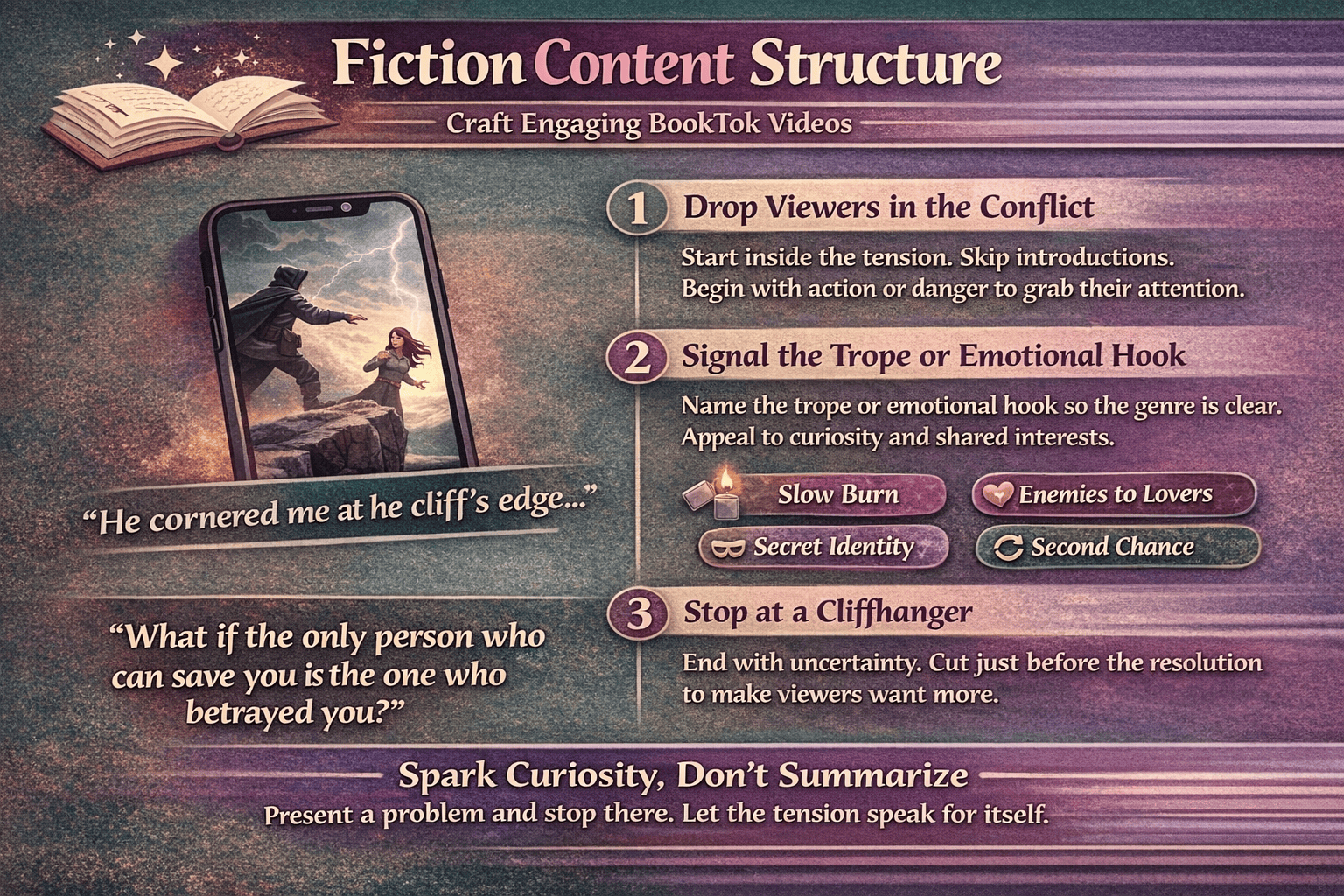
Fiction content structure
Fiction videos work best when they feel like the opening lines of a scene rather than a book summary.
Start inside the tension. Instead of introducing yourself or explaining the plot, drop the viewer directly into the conflict.
Then name the emotional hook or trope so the genre is easy to recognize, like “Slow burn”, “Revenge”, “Secret identity”, and “Second chance”.
Finally, stop before the resolution. Curiosity keeps people watching longer than explanation does.
For example:
“What if the only person who can save you is the one who betrayed you?”
That line presents a problem and leaves it open. It does not summarize the book. It creates tension.
A common mistake fiction authors make is explaining their story instead of dramatizing it. Summary gives information while tension creates interest.

Nonfiction content structure
Nonfiction videos should feel focused and useful from the start.
Begin by naming a specific struggle your audience recognizes.
“If you keep repeating the same mistakes…”
Then give one clear insight. One strong point is easier to absorb than five scattered ideas.
Finally, offer a next step, like “Read the book”, “Try the method”, or “Follow for more guidance”.
For example:
“Doing the same things expecting a different outcome is just a waste of your time.”
That opening challenges a belief and promises clarity.
The Nonfiction Authors Association advises centering content around specific reader problems instead of general promotion because audiences respond more strongly to clear value.
Remember: Fiction invites the viewer into a moment while Nonfiction gives the viewer a solution.
Once you understand which experience your book offers, structuring your videos becomes much more straightforward.
Want more examples of hooks and content structures you can adapt to your book? Check out my resources for templates, prompts, and practical tools designed for authors building their platform.

Do authors need to follow trends to build visibility?
Trends are not required to build visibility on BookTok.
They can create a short burst of reach, but the platform distributes videos based on how viewers respond to them. Watch time, comments, shares, and replays carry more weight than whether you used a trending sound. TikTok explains this directly in its documentation on content recommendations.
If someone watches your full video about “second chance romance,” that sends a strong signal. If they scroll past a trendy video that feels unclear or forced, that sends a weak one.
The system responds to engagement patterns, not performance style.
Videos that clearly show who their intended audience is outperforms trend-chasing videos in the long run.
What you can borrow from trends
You do not need to copy trends, but you can learn from them. Many trends reveal patterns that hold attention.
- Fast hooks
Trending videos often state the main idea within the first two seconds. That pacing works in any genre. - Clear on-screen text
Short, readable phrases help viewers understand your book even with the sound off. - Direct captions
“Check out this new Small-town murder mystery” communicates more clearly than “My book is finally here.”
These are structural choices. They help viewers process your message quickly.
What you should not copy
- A personality that isn’t yours
Exaggerated reactions only work if they feel natural. - Forced humor
If you feel uncomfortable delivering it, viewers will sense that. - Energy you cannot maintain
If filming leaves you drained, you will avoid posting.
Many authors burn out because they try to match creators whose strengths are different from theirs. A strong #BookTok strategy for authors should feel sustainable.
If you can imagine using the same format next month without hesitation, you have likely chosen the right approach.
Still unsure whether a trend fits your book or your voice? Contact me with any questions, and I’ll help you decide what makes sense for your specific genre and goals.

Should you appear on camera, or are other formats effective?
You do not have to appear on camera to succeed on BookTok.
What matters is not whether your face is visible. What matters is whether viewers understand your message and whether you can keep posting consistently.
Some authors enjoy speaking directly to the camera. Others feel more comfortable letting the words or visuals carry the message. Both approaches can work.
The Alliance of Independent Authors explains that slideshow and text-overlay formats are effective promotional tools, especially for authors who prefer a simpler setup.
That means you have real options.
On-camera format examples
If you are comfortable speaking, on-camera videos can build familiarity and connection.
- Direct Q&A
“Is this book part of a series?”
“Is this romance closed-door or open-door?” - Hook-based storytelling
Start with one strong line and expand briefly. - Recurring series themes
“Trope Tuesday.”
“Fantasy Worldbuilding Facts.”
These formats work well when you enjoy speaking and can deliver your message clearly in a short time.
Off-camera format examples
If you prefer not to film yourself, you can focus on clarity and mood instead of personality.
- Text overlay on simple background video
Short phrases that clearly signal genre or theme. - Book aesthetic montage
Visuals that match tone, setting, or character dynamics. - Quote slides
A single line that communicates tension or insight. - Replying to comments with text
Answer reader questions without recording yourself.
Consider two authors with the same romance novel. One forces high-energy reactions on camera even though it feels unnatural. The other posts simple text videos that clearly say “slow burn, small-town romance.” The second author is more likely to post consistently.
Consistency builds recognition. Recognition builds familiarity.
Choose the format you can repeat without hesitation. A sustainable BookTok strategy for authors depends on clarity and repetition, not appearance.
Trying to decide which format fits you best but want feedback from someone experienced? Check out my services to get personalized guidance on building a #BookTok strategy that feels natural and sustainable.

How does your author career stage affect your #BookTok strategy?
Your stage as an author changes what your videos should accomplish.
- A writer without a published book needs visibility and recognition.
- An author in launch week needs repetition and reinforcement.
- An author with a backlist needs rediscovery and clear entry points.
When you use the same content approach at every stage, you waste effort.
Most people on TikTok are watching, not posting. According to Pew Research , about half of adult users never create content. That means readers may see your videos multiple times before they take action.
Because buying a book is rarely an instant decision, steady visibility matters more than one big spike.
Pre-release authors
If your book is not out yet, your main goal is recognition.
You want readers to associate your name with a specific type of story.
Focus on:
- Making your genre unmistakable
- Sharing core themes and emotional stakes
- Inviting viewers to follow or join your email list
Instead of saying, “My book comes out soon,” say,
“If you love small-town romance with a slow burn, this story is for you.”
You are training both readers and the platform to connect you with that experience.
Launch-phase authors
If your book just released, repetition becomes your advantage.
Focus on:
- Repeating your strongest hook in different ways
- Sharing early reader reactions or reviews
- Reinforcing the same tropes and themes consistently
Most viewers will not see every video you post. Repeating your message helps it stick.
Established authors with a backlist
If you have multiple books, your goal shifts to guiding readers.
Focus on:
- Telling readers where to start
- Highlighting strong character arcs
- Reintroducing older titles with fresh framing
For example:
“If you love morally gray heroes, start with Book One.”
When readers encounter your work more than once, it becomes familiar. Familiar books feel easier to try.
The stage of your author career does not determine whether #BookTok can work. It determines what each video should help the viewer do.
Not sure what your focus should be at your current stage? Sign up for a free 30 minute consultation call, and we’ll map out a clear next step for your platform.

What does success look like beyond going viral?
A viral video can bring attention, but it does not guarantee book sales or long-term growth. What matters more is whether the right readers are steadily moving closer to your work.
It helps to remember that most people on TikTok are viewers. They scroll, watch, and decide over time whether or not they want to give something a try.
Because of that, readers often need to see your book more than once before they click a link or make a purchase.
Instead of focusing on views alone, focus on movement. Are readers taking small steps forward?
Practical metrics to track
- Profile visits increasing over time
When more viewers tap your profile after watching a video, your hook and genre signal are working. - Comments asking specific questions
Questions like “Is this part of a series?” or “When does it release?” show real interest, not casual scrolling. - Link-in-bio clicks rising slowly
Even small increases matter. Clicking a link is a stronger action than liking a video. - Steady follower growth
Slow growth often means your content is attracting the right readers, not random traffic. - Repeat usernames in your comments
Seeing the same names again shows retention. Retention builds trust which turn into loyal readers over time.
Virality is unpredictable but clear engagement patterns are easier to observe and measure.
If your numbers are moving in small, steady ways, your #BookTok strategy for authors is doing its job.
Final Thoughts
A strong #BookTok strategy for authors is built on clarity and consistency. When your genre is easy to recognize, your format fits your energy, and your content matches your current stage as a writer, your efforts start to work together instead of feeling scattered.
You don’t need to be louder, chase every trend, or post every single day. What matters is that readers can quickly understand the experience your book offers and that you show up often enough for that message to stick.
Most readers won’t act the first time they see your book. They notice it, see it again, and slowly become familiar with it. When your approach is clear and repeatable, that familiarity builds over time.
That’s what turns occasional posting into a long-term #BookTok strategy for authors.
Free Resource: Build Your #BookTok Strategy
Download the #BookTok Strategy Builder Workbook and create a plan that fits your genre, your comfort level, and your current stage as an author.
Inside you’ll clarify:
- Your reader signals
- Your repeatable format
- Your 30-day focus plan
- Your primary visibility goal
The goal is simple: stop posting randomly and start building recognition.
Want a #BookTok Strategy That Actually Fits Your Genre and Schedule?
If TikTok makes sense for your books, but you’re unsure how to turn that into a clear, repeatable plan, this is where focused support makes the difference.
My Social Media Strategy for Authors is built around structure, not noise.
With this service, you get:
- A #BookTok and platform plan tailored to your genre and career stage
- Clear direction on what to post, what to repeat, and what to ignore
- A sustainable system that supports your writing life instead of overwhelming it
You don’t need more ideas. You need a strategy that fits.

Leave a Reply